



![(6-bromoimidazo[1,2-a]pyridin-2-yl)methanol](https://www.chemshuttle.com/media/catalog/product/cache/31dbf0bffbfa69a5826a72cec9a446de/1/9/192631_2.jpg)
![1-methylimidazo[1,5-a]pyridine-3-carboxylic acid](https://www.chemshuttle.com/media/catalog/product/cache/31dbf0bffbfa69a5826a72cec9a446de/1/9/192633_2.jpg)
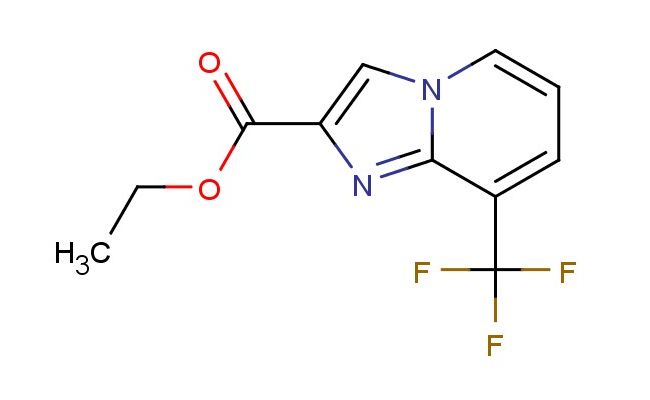
ethyl 8-(trifluoromethyl)imidazo[1,2-a]pyridine-2-carboxylate
$300.00
CAS No.: 1363404-84-5
Catalog No.: 192632
Purity: 95%
MF: C11H9F3N2O2
MW: 258.199
Storage: 2-8 degree Celsius
SMILES: FC(C=1C=2N(C=CC1)C=C(N2)C(=O)OCC)(F)F
Catalog No.: 192632
Purity: 95%
MF: C11H9F3N2O2
MW: 258.199
Storage: 2-8 degree Celsius
SMILES: FC(C=1C=2N(C=CC1)C=C(N2)C(=O)OCC)(F)F
For R&D use only. Not for human or veterinary use.
![8-(trifluoromethyl)imidazo[1,2-a]pyridine-2-carboxylic acid](https://www.chemshuttle.com/media/catalog/product/cache/eda3e020a548044183bce7a8a96486f8/1/9/192625_2.jpg)
![8-(trifluoromethyl)imidazo[1,2-a]pyridine](https://www.chemshuttle.com/media/catalog/product/cache/eda3e020a548044183bce7a8a96486f8/z/b/zb2095.jpg)
ethyl 8-(trifluoromethyl)imidazo[1,2-a]pyridine-2-carboxylate; CAS No.: 1363404-84-5; ethyl 8-(trifluoromethyl)imidazo[1,2-a]pyridine-2-carboxylate. PROPERTIES: This trifluoromethyl-containing heterocyclic ester has molecular formula C11H9F3N2O2. It generally appears as a pale yellow crystalline powder. The ethyl 8-(trifluoromethyl)imidazo[1,2-a]pyridine-2-carboxylate demonstrates good solubility in polar aprotic solvents such as acetone and ethyl acetate while being sparingly soluble in water. Its melting point is approximately 89-92 C with a molecular weight of about 266.2 g/mol. Standard protective measures should be employed during handling, including laboratory coats and chemical-resistant goggles. Storage requirements include a cool, dry environment preferably below 30 C in an amber glass container to prevent photodegradation. The compound may decompose upon exposure to strong bases or high temperatures, releasing toxic fumes. In case of skin contact, washing with soap and water is recommended. APPLICATIONS: The ethyl 8-(trifluoromethyl)imidazo[1,2-a]pyridine-2-carboxylate is primarily utilized as a synthetic intermediate in the production of agricultural fungicides where the trifluoromethyl group enhances lipophilicity and membrane permeability (as reported in pesticide chemistry journals). Its ester functionality can be hydrolyzed under controlled conditions to yield the corresponding carboxylic acid, which serves as a key intermediate in pesticide formulations. Additionally, the compound functions as a fluorogenic substrate in biochemical assays for detecting esterase activity in various biological samples, with detection limits in the nanomolar range as described in analytical chemistry publications. The trifluoromethyl group also contributes to the compound's utility in materials science as a building block for liquid crystal materials with specific electro-optical properties.
Reviews
Write Your Own Review