


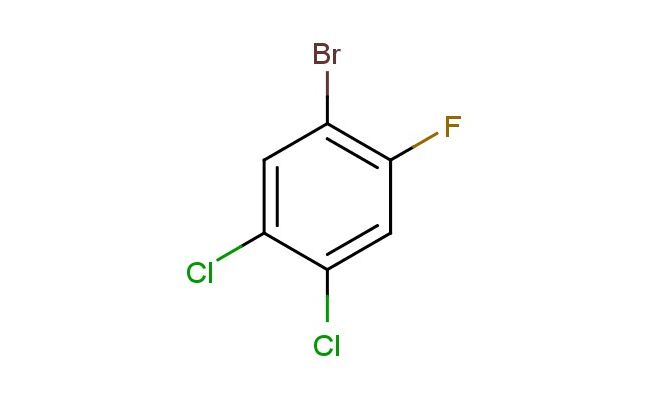


1-bromo-4,5-dichloro-2-fluorobenzene
$250.00
CAS No.: 1000572-78-0
Catalog No.: 194969
Purity: 95%
MF: C6H2BrCl2F
MW: 243.89
Storage: 2-8 degree Celsius
SMILES: BrC1=C(C=C(C(=C1)Cl)Cl)F
Catalog No.: 194969
Purity: 95%
MF: C6H2BrCl2F
MW: 243.89
Storage: 2-8 degree Celsius
SMILES: BrC1=C(C=C(C(=C1)Cl)Cl)F
For R&D use only. Not for human or veterinary use.
1-bromo-4,5-dichloro-2-fluorobenzene; CAS No.: 1000572-78-0; 1-bromo-4,5-dichloro-2-fluorobenzene. PROPERTIES: 1-bromo-4,5-dichloro-2-fluorobenzene presents as colorless liquid with molecular formula C6H3BrCl2F. It has a boiling point of approximately 198-200 C and a density of 1.85 g/mL at 25 C. The compound is immiscible with water but dissolves well in non-polar solvents like hexane, toluene, and dichloromethane. It is light-sensitive and forms peroxides upon prolonged storage. Recommended storage involves keeping in nitrogen-purged, amber glass bottles with inhibitors at temperatures below 5 C. From a safety perspective, this halogenated benzene derivative exhibits significant acute toxicity - classified as toxic via inhalation (LC50 ~150 mg/m?) and skin contact. It poses severe eye damage risk and is suspected of causing organ toxicity upon repeated exposure. Handling requires use of chemical-resistant clothing, full-facepiece respirators with organic vapor cartridges, and safety showers/eyewash stations. APPLICATIONS: In specialty chemical synthesis, 1-bromo-4,5-dichloro-2-fluorobenzene functions as a building block for creating mixed-halogen aryl compounds. The bromine provides a reactive handle for Suzuki couplings while the chloro and fluoro groups direct subsequent electrophilic substitutions (Tetrahedron Letters). In the field of materials science, the compound serves as a monomer for producing high-temperature resistant polymers used in aerospace applications. The multiple halogen substituents enhance flame retardancy through radical scavenging mechanisms (Polymer Chemistry). In analytical toxicology, the compound acts as an internal standard for GC-MS analysis of environmental pollutants. Its unique halogenation pattern provides distinct fragmentation ions allowing quantification of trace levels of related contaminants with precision <5% RSD (Analytical Toxicology). In the development of liquid crystal mixtures, the compound contributes to formulation of nematic phases with optimal dielectric anisotropy for display applications (Liquid Crystals).
Reviews
Write Your Own Review