


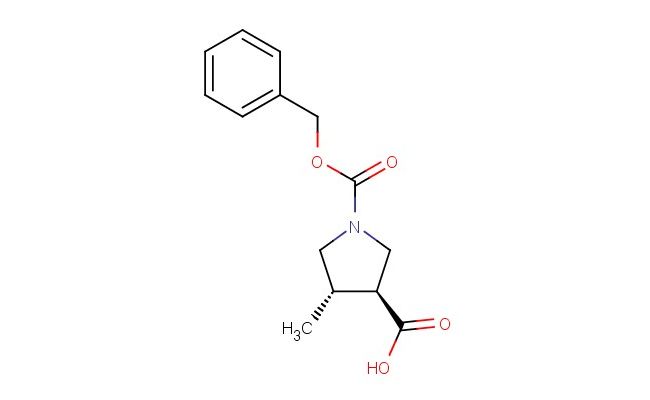


(trans)-1-(benzyloxycarbonyl)-4-methylpyrrolidine-3-carboxylic acid
$250.00
CAS No.: 1402666-47-0
Catalog No.: 192994
Purity: 95%
MF: C14H17NO4
MW: 263.293
Storage: 2-8 degree Celsius
SMILES: C(C1=CC=CC=C1)OC(=O)N1C[C@H]([C@@H](C1)C)C(=O)O
Catalog No.: 192994
Purity: 95%
MF: C14H17NO4
MW: 263.293
Storage: 2-8 degree Celsius
SMILES: C(C1=CC=CC=C1)OC(=O)N1C[C@H]([C@@H](C1)C)C(=O)O
For R&D use only. Not for human or veterinary use.
(trans)-1-(benzyloxycarbonyl)-4-methylpyrrolidine-3-carboxylic acid; CAS No.: 1402666-47-0; (trans)-1-(benzyloxycarbonyl)-4-methylpyrrolidine-3-carboxylic acid. PROPERTIES: This compound appears as a white crystalline powder with molecular formula C14H15NO4 and a molecular weight of 261.28 g/mol. It demonstrates a melting point in the range of 168-172 C and shows moderate solubility in common organic solvents like methanol and ethyl acetate. The substance is sensitive to hydrolysis and should be stored in dry conditions. Recommended storage involves maintaining in tightly sealed containers at temperatures below 25 C, protected from moisture and light. When handling, standard laboratory safety protocols should be followed, including the use of protective gloves and eye wear, as (trans)-1-(benzyloxycarbonyl)-4-methylpyrrolidine-3-carboxylic acid may cause skin irritation. The carboxylic acid group requires careful handling in strongly basic environments. APPLICATIONS: In the pharmaceutical industry, (trans)-1-(benzyloxycarbonyl)-4-methylpyrrolidine-3-carboxylic acid serves as an intermediate for synthesizing non-steroidal anti-inflammatory drugs (NSAIDs), as described in medicinal chemistry literature focusing on pyrrolidine derivatives. Its benzyloxycarbonyl substituent enables controlled deprotection strategies in multi-step syntheses. Additionally, this compound functions as a building block for preparing agrochemicals with fungicidal activities through coupling reactions. Academic research has explored its potential in metal coordination chemistry for creating luminescent sensors, as reported in inorganic chemistry journals. The pyrrolidine ring system also facilitates formation of metal-organic frameworks (MOFs), making it valuable for gas storage applications in materials science, as evidenced by studies in crystallography publications.
Reviews
Write Your Own Review