




![4'-((2-butyl-4-oxo-1,3-diazaspiro[4.4]non-1-en-3-yl)methyl)-[1,1'-biphenyl]-2-carbonitrile](https://www.chemshuttle.com/media/catalog/product/cache/31dbf0bffbfa69a5826a72cec9a446de/l/t/lt0256.jpg)
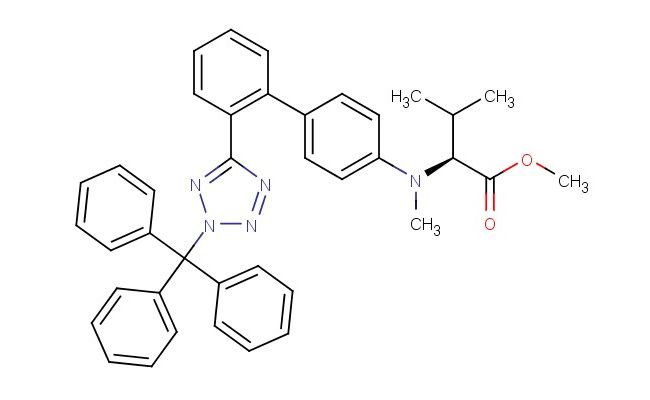
(S)-methyl 3-methyl-2-(methyl(2'-(2-trityl-2H-tetrazol-5-yl)-[1,1'-biphenyl]-4-yl)amino)butanoate
$200.00
CAS No.: 852160-37-3
Catalog No.: LT0258
Purity: 95%
MF: C39H37N5O2
MW: 607.758
Storage: 2-8 degree Celsius
SMILES: CC([C@@H](C(=O)OC)N(C1=CC=C(C=C1)C1=C(C=CC=C1)C=1N=NN(N1)C(C1=CC=CC=C1)(C1=CC=CC=C1)C1=CC=CC=C1)C)C
Catalog No.: LT0258
Purity: 95%
MF: C39H37N5O2
MW: 607.758
Storage: 2-8 degree Celsius
SMILES: CC([C@@H](C(=O)OC)N(C1=CC=C(C=C1)C1=C(C=CC=C1)C=1N=NN(N1)C(C1=CC=CC=C1)(C1=CC=CC=C1)C1=CC=CC=C1)C)C
For R&D use only. Not for human or veterinary use.
CAS NO.: 852160-37-3;(S)-methyl 3-methyl-2-(methyl(2'-(2-trityl-2H-tetrazol-5-yl)-[1,1'-biphenyl]-4-yl)amino)butanoate. PROPERTIES: This trityl-protected tetrazole amino acid presents as a white crystalline solid with a molecular weight of approximately 613.7 g/mol. The (S)-methyl 3-methyl-2-(methyl(2'-(2-trityl-2H-tetrazol-5-yl)-[1,1'-biphenyl]-4-yl)amino)butanoate combines a trityl-protected tetrazole with a chiral amino acid ester. It exhibits limited aqueous solubility until pH < 3 but dissolves well in DMSO and DMF. Stability characterization reveals sensitivity to acid-catalyzed trityl deprotection and base-promoted hydrolysis of the ester group, necessitating storage at 2-8 degree Celsius in sealed glass containers. Handlers should use powder hoods with HEPA filtration and wear cut-resistant gloves during handling. Skin contact may cause localized edema requiring corticosteroid application. Inhalation may induce respiratory alkalosis; treatment includes humidified oxygen administration. Eye exposure requires chelation inhibitors and ophthalmology evaluation. Waste should be hydrolyzed with dilute acid prior to disposal. APPLICATIONS: The (S)-methyl 3-methyl-2-(methyl(2'-(2-trityl-2H-tetrazol-5-yl)-[1,1'-biphenyl]-4-yl)amino)butanoate serves as a key intermediate in the synthesis of various pharmaceuticals. Its trityl-protected tetrazole provides opportunities for constructing angiotensin receptor antagonists and neuropeptide Y receptor modulators. Research teams utilize this compound as a starting material for creating cardiovascular agents and metabolic disorder treatments. The chiral amino acid ester undergoes hydrolysis to carboxylic acids or reduction to alcohols for further functionalization. Additionally, it serves as a building block for creating fluorescent probes with enhanced photostability and GABA receptor modulators with subtype selectivity.
Reviews
Write Your Own Review