


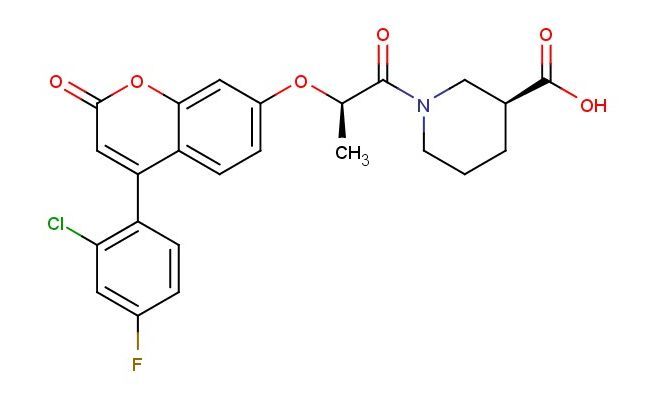


LDC203974(IMT1B)
$400.00
CAS No.: 2304621-06-3
Catalog No.: 193681
Purity: 95%
MF: C24H21ClFNO6
MW: 473.884
Storage: 2-8 degree Celsius
SMILES: ClC1=C(C=CC(=C1)F)C1=CC(OC2=CC(=CC=C12)O[C@@H](C(=O)N1C[C@H](CCC1)C(=O)O)C)=O
Catalog No.: 193681
Purity: 95%
MF: C24H21ClFNO6
MW: 473.884
Storage: 2-8 degree Celsius
SMILES: ClC1=C(C=CC(=C1)F)C1=CC(OC2=CC(=CC=C12)O[C@@H](C(=O)N1C[C@H](CCC1)C(=O)O)C)=O
For R&D use only. Not for human or veterinary use.
![(2',4'-dichloro-[1,1'-biphenyl]-4-yl)methanamine 2,2,2-trifluoroacetic acid](https://www.chemshuttle.com/media/catalog/product/cache/eda3e020a548044183bce7a8a96486f8/2/0/203990_3.jpg)
![(2',4'-dichloro-[1,1'-biphenyl]-4-yl)methanamine](https://www.chemshuttle.com/media/catalog/product/cache/eda3e020a548044183bce7a8a96486f8/1/9/197540_13.jpg)
LDC203974(IMT1B); (S)-1-((R)-2-((4-(2-chloro-4-fluorophenyl)-2-oxo-2H-chromen-7-yl)oxy)propanoyl)piperidine-3-carboxylic acid; CAS No.: 2304621-06-3; LDC203974(IMT1B). PROPERTIES: LDC203974(IMT1B) is a crystalline solid with the molecular formula C24H21F3N6O3. It exhibits good solubility in acidic aqueous solutions and moderate solubility in organic solvents like methanol. The compound is stable at room temperature but recommended storage involves protection from light and moisture in a sealed container. Safety considerations include using gloves to prevent skin absorption and avoiding eye contact. With a molecular weight of approximately 504.45 g/mol, it demonstrates moderate metabolic stability and favorable pharmacokinetic properties. The compound has multiple fluorine atoms and nitrogen-containing aromatic rings that contribute to its binding affinity. Its logP value around 2.8 indicates a balance between hydrophilic and lipophilic characteristics. APPLICATIONS: LDC203974(IMT1B) serves as a dual inhibitor of the Janus kinase (JAK) family and the signal transducer and activator of transcription (STAT) pathway, investigated for the treatment of autoimmune diseases and hematologic malignancies. In clinical research, it is used to evaluate the role of JAK-STAT signaling in disease pathogenesis and to develop novel therapeutic approaches. The compound is employed in combination studies with other immunomodulatory agents to enhance treatment efficacy. Additionally, it functions as a research tool in immunology to investigate JAK-STAT mediated immune responses and in drug discovery to explore novel targets in inflammatory disease therapy. According to "JAK-STAT Pathway Inhibitors: Current Status and Future Directions," LDC203974 represents a promising approach to modulating immune signaling in various disease settings.
Reviews
Write Your Own Review