


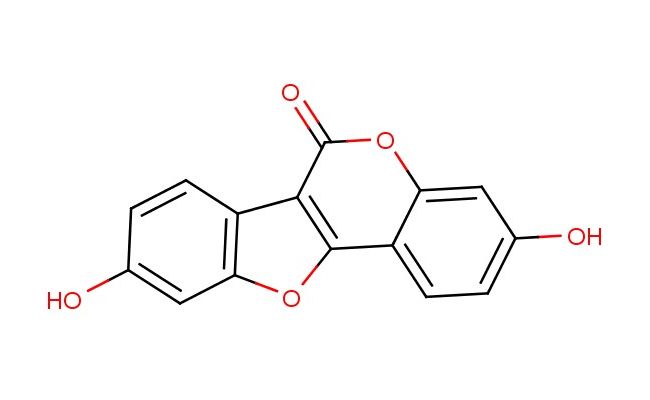


Coumestrol
$300.00
CAS No.: 479-13-0
Catalog No.: 194881
Purity: 95%
MF: C15H8O5
MW: 268.224
Storage: 2-8 degree Celsius
SMILES: OC1=CC=C2C3=C(C(OC2=C1)=O)C1=C(O3)C=C(C=C1)O
Catalog No.: 194881
Purity: 95%
MF: C15H8O5
MW: 268.224
Storage: 2-8 degree Celsius
SMILES: OC1=CC=C2C3=C(C(OC2=C1)=O)C1=C(O3)C=C(C=C1)O
For R&D use only. Not for human or veterinary use.
![7-[4-[4-(2,3-dichlorophenyl)piperazin-1-yl]butoxy]-1-[4-[(2-oxo-3,4-dihydro-1H-quinolin-7-yl)oxy]butyl]-3,4-dihydroquinolin-2-one](https://www.chemshuttle.com/media/catalog/product/cache/eda3e020a548044183bce7a8a96486f8/2/0/205403.jpg)
Coumestrol; 3,9-dihydroxy-6H-benzofuro[3,2-c]chromen-6-one; CAS No.: 479-13-0;Coumestrol. PROPERTIES: Coumestrol is a white or off-white crystalline powder with a molecular formula of C15H10O5 and a molecular weight of 265.24 g/mol. It has limited aqueous solubility but dissolves in methanol and ethanol. Storage should be at room temperature in a sealed container protected from light and moisture. When handling, avoid skin contact and ingestion due to its potential to exhibit phytoestrogenic effects. APPLICATIONS: Coumestrol is a phytoestrogen found in certain legumes. In nutritional research, it serves as a model compound for studying phytoCAS No.: 1196541-47-5;GDC-0575 (ARRY-575). PROPERTIES: GDC-0575 is an orally bioavailable small molecule inhibitor of aurora kinases. It appears as a white to off-white powder with a molecular formula of C27H26N6O3 and a molecular weight of 490.55 g/mol. The compound exhibits moderate aqueous solubility and dissolves readily in DMSO. Proper storage requires maintaining it at -20 C in a tightly sealed container protected from light and moisture. When handling GDC-0575, protective measures such as gloves, eye protection, and lab coats are recommended due to its potential cytotoxic effects. APPLICATIONS: GDC-0575 is primarily used in oncology research for its aurora kinase inhibitory activity. It demonstrates selective inhibition of aurora A and B kinases, leading to mitotic arrest and apoptosis in various cancer cell lines including leukemia, lung, and colorectal cancer cells. Preclinical studies have shown its efficacy in combination with other chemotherapeutic agents, enhancing cytotoxic effects while reducing individual drug doses (source: Journal of Medicinal Chemistry). Additionally, GDC-0575 has been explored in drug resistance studies, where it helps overcome resistance mechanisms in cancer treatment by targeting mitotic regulators (source: Cancer Research).
Reviews
Write Your Own Review