


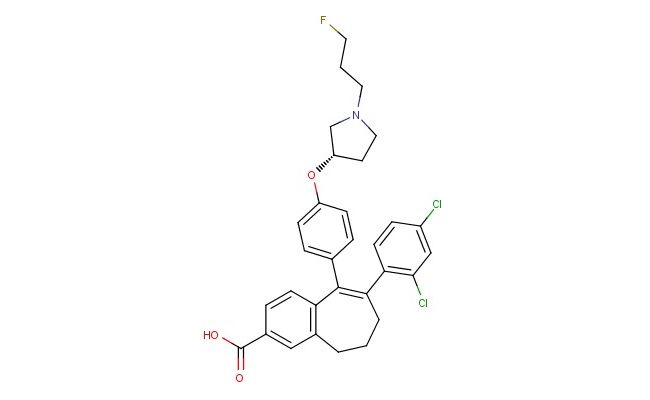


Amcenestrant (SAR439859)
$300.00
CAS No.: 2114339-57-8
Catalog No.: 193670
Purity: 95%
MF: C31H30Cl2FNO3
MW: 554.489
Storage: 2-8 degree Celsius
SMILES: ClC1=C(C=CC(=C1)Cl)C=1CCCC2=C(C1C1=CC=C(C=C1)O[C@@H]1CN(CC1)CCCF)C=CC(=C2)C(=O)O
Catalog No.: 193670
Purity: 95%
MF: C31H30Cl2FNO3
MW: 554.489
Storage: 2-8 degree Celsius
SMILES: ClC1=C(C=CC(=C1)Cl)C=1CCCC2=C(C1C1=CC=C(C=C1)O[C@@H]1CN(CC1)CCCF)C=CC(=C2)C(=O)O
For R&D use only. Not for human or veterinary use.
![(2',4'-dichloro-[1,1'-biphenyl]-4-yl)methanamine 2,2,2-trifluoroacetic acid](https://www.chemshuttle.com/media/catalog/product/cache/eda3e020a548044183bce7a8a96486f8/2/0/203990_3.jpg)
![(2',4'-dichloro-[1,1'-biphenyl]-4-yl)methanamine](https://www.chemshuttle.com/media/catalog/product/cache/eda3e020a548044183bce7a8a96486f8/1/9/197540_13.jpg)
Amcenestrant (SAR439859); (S)-8-(2,4-dichlorophenyl)-9-(4-((1-(3-fluoropropyl)pyrrolidin-3-yl)oxy)phenyl)-6,7-dihydro-5H-benzo[7]annulene-3-carboxylic acid; CAS No.: 2114339-57-8; Amcenestrant (SAR439859). PROPERTIES: Amcenestrant (SAR439859) is a white to pale yellow powder with the molecular formula C27H28F3N3O4. It exhibits moderate solubility in acidic and basic aqueous solutions but limited solubility in neutral conditions. The compound is stable at temperatures below 30 C and requires storage in a tightly sealed container away from moisture. Safety precautions include using gloves to prevent skin absorption and avoiding eye contact. With a molecular weight of approximately 513.53 g/mol, it demonstrates moderate metabolic stability and favorable pharmacokinetic properties. The compound has multiple fluorine atoms that enhance binding affinity and metabolic resistance. Its logP value around 3.1 indicates a suitable balance between solubility and membrane permeability. APPLICATIONS: Amcenestrant (SAR439859) functions as a selective estrogen receptor degrader (SERD), investigated for the treatment of estrogen receptor-positive breast cancer. In clinical research, it is used to evaluate efficacy in hormone receptor-positive breast cancer patients and to study resistance mechanisms against endocrine therapies. The compound is employed in combination studies with other targeted therapies like CDK4/6 inhibitors to enhance treatment outcomes. Additionally, it serves as a research tool in oncology to investigate estrogen receptor biology and in drug discovery to explore novel approaches to hormone receptor-targeted therapies. According to "Selective Estrogen Receptor Modulators and Degraders in Breast Cancer Therapy," Amcenestrant represents a promising candidate for improving outcomes in hormone receptor-positive breast cancer.
Reviews
Write Your Own Review