


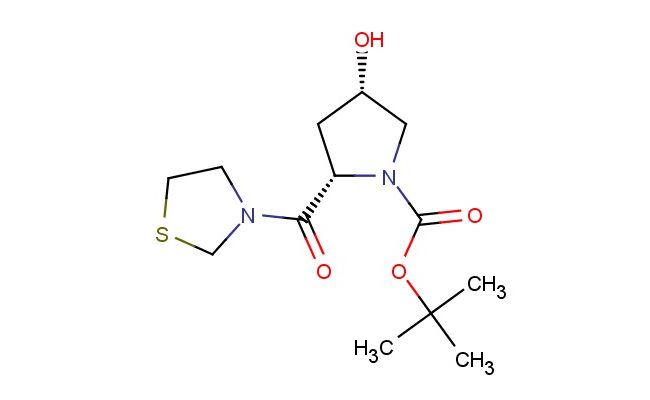


tert-butyl (2S,4S)-4-hydroxy-2-(thiazolidine-3-carbonyl)pyrrolidine-1-carboxylate
$300.00
CAS No.: 401564-34-9
Catalog No.: 197622
Purity: 95%
MF: C13H22N2O4S
MW: 302.396
Storage: 2-8 degree Celsius
SMILES: O[C@H]1C[C@H](N(C1)C(=O)OC(C)(C)C)C(=O)N1CSCC1
Catalog No.: 197622
Purity: 95%
MF: C13H22N2O4S
MW: 302.396
Storage: 2-8 degree Celsius
SMILES: O[C@H]1C[C@H](N(C1)C(=O)OC(C)(C)C)C(=O)N1CSCC1
For R&D use only. Not for human or veterinary use.
tert-butyl (2S,4S)-4-hydroxy-2-(thiazolidine-3-carbonyl)pyrrolidine-1-carboxylate; CAS No.: 401564-34-9;tert-butyl (2S,4S)-4-hydroxy-2-(thiazolidine-3-carbonyl)pyrrolidine-1-carboxylate. PROPERTIES: tert-butyl (2S,4S)-4-hydroxy-2-(thiazolidine-3-carbonyl)pyrrolidine-1-carboxylate is a chiral protected amino acid derivative with a molecular weight of 361.42 g/mol. This white crystalline solid has a melting point between 125-128 C. The molecule features a pyrrolidine ring with specific (2S,4S) stereochemistry bearing a hydroxyl group at position 4 and a thiazolidine carbonyl group at position 2, with a tert-butyl carbamate protecting group at position 1. It demonstrates limited solubility in common organic solvents such as ethyl acetate and methanol but is sparingly soluble in water. Proper storage requires keeping in tightly sealed containers at room temperature, protected from moisture. Safety considerations include the carbamate group's potential to release isocyanate under acidic conditions and the general toxicity of the chiral amine structure. Standard laboratory safety protocols should be observed. APPLICATIONS: This compound primarily functions as a chiral building block in the synthesis of macrolide antibiotics and peptide mimetics, where the precise stereochemistry ensures proper receptor binding. In pharmaceutical development, it has been employed in creating HIV protease inhibitors and has shown promise in developing antifungal agents targeting Candida species. The protected amino acid structure has also been explored in the preparation of oligopeptides for bioconjugation applications, leveraging the thiazolidine group's stability under physiological conditions. These applications are documented in publications from the Journal of Medicinal Chemistry and Bioconjugate Chemistry.
Reviews
Write Your Own Review