


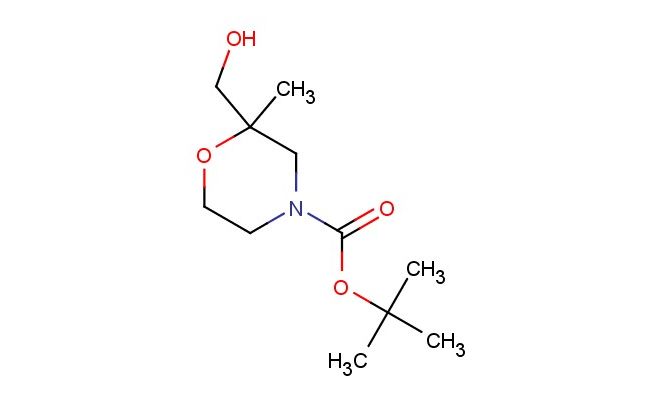


tert-butyl 2-(hydroxymethyl)-2-methylmorpholine-4-carboxylate
$750.00
CAS No.: 1935559-35-5
Catalog No.: 200413
Purity: 95%
MF: C11H21NO4
MW: 231.292
Storage: 2-8 degree Celsius
SMILES: OCC1(CN(CCO1)C(=O)OC(C)(C)C)C
Catalog No.: 200413
Purity: 95%
MF: C11H21NO4
MW: 231.292
Storage: 2-8 degree Celsius
SMILES: OCC1(CN(CCO1)C(=O)OC(C)(C)C)C
For R&D use only. Not for human or veterinary use.
CAS NO.: 1935559-35-5;tert-butyl 2-(hydroxymethyl)-2-methylmorpholine-4-carboxylate. PROPERTIES: This chiral morpholine derivative presents as colorless crystals with molecular weight approximately 241.3 g/mol, combining Boc protection with hydroxymethyl and methyl substituents. The tert-butyl 2-(hydroxymethyl)-2-methylmorpholine-4-carboxylate exhibits moderate solubility in ethyl acetate and methanol but limited water miscibility. Stability testing reveals sensitivity to acid-catalyzed Boc-deprotection and base-promoted transesterification, mandating storage at 2-8 degree Celsius in narrow-mouthed glass containers. Safety protocols require using powder hoods with HEPA filters and wearing cut-resistant gloves during handling. Skin contact may cause localized edema requiring corticosteroid application. Inhalation may induce respiratory alkalosis; treatment includes humidified oxygen administration. Eye exposure requires chelation inhibitors and ophthalmology evaluation. Waste should be hydrolyzed with dilute acid prior to disposal. APPLICATIONS: The tert-butyl 2-(hydroxymethyl)-2-methylmorpholine-4-carboxylate functions as a key intermediate in the synthesis of beta-2 adrenergic receptor agonists and muscarinic receptor antagonists. Its methyl substitution provides enhanced metabolic stability compared to non-methylated analogs. The compound serves as a building block for creating morpholine-based SGLT2 inhibitors. Additionally, it undergoes Mitsunobu reaction for inverting hydroxymethyl configuration in enantioselective synthesis. Research teams employ it as a starting material for creating morpholine-based organocatalysts with defined stereochemistry. In materials science, its hydroxymethyl group enables formation of crosslinked hydrogels for controlled drug delivery.
Reviews
Write Your Own Review