



![2-(pyridin-4-yl)benzo[d]oxazol-6-amine](https://www.chemshuttle.com/media/catalog/product/cache/31dbf0bffbfa69a5826a72cec9a446de/t/q/tqp2232_1.jpg)
![7-bromo-2-phenylbenzo[d]oxazole](https://www.chemshuttle.com/media/catalog/product/cache/31dbf0bffbfa69a5826a72cec9a446de/t/q/tqp2235_1.jpg)
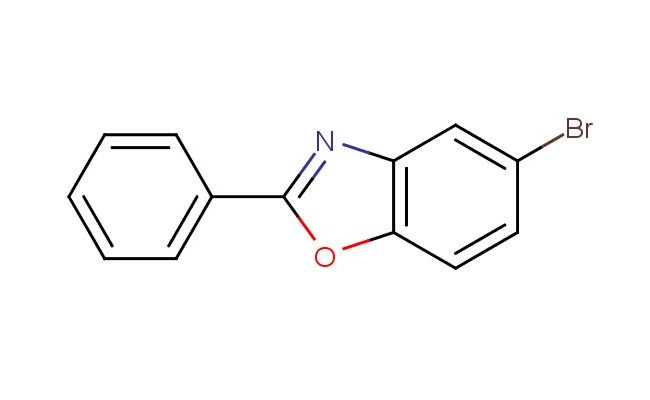
5-bromo-2-phenylbenzo[d]oxazole
$215.00
CAS No.: 69918-19-0
Catalog No.: TQP2234
Purity: 95%
MF: C13H8BrNO
MW: 274.117
Storage: 2-8 degree Celsius
SMILES: BrC=1C=CC2=C(N=C(O2)C2=CC=CC=C2)C1
Catalog No.: TQP2234
Purity: 95%
MF: C13H8BrNO
MW: 274.117
Storage: 2-8 degree Celsius
SMILES: BrC=1C=CC2=C(N=C(O2)C2=CC=CC=C2)C1
For R&D use only. Not for human or veterinary use.
![7-bromo-2,2-diethyl-3,4-dihydro-2H-benzo[b][1,4]oxazine](https://www.chemshuttle.com/media/catalog/product/cache/eda3e020a548044183bce7a8a96486f8/2/0/204281_2.jpg)
![7-bromo-2,2-difluoro-2H-benzo[b][1,4]oxazin-3(4H)-one](https://www.chemshuttle.com/media/catalog/product/cache/eda3e020a548044183bce7a8a96486f8/2/0/202434_6.jpg)
![5-bromo-3-chlorobenzo[d]isoxazole](https://www.chemshuttle.com/media/catalog/product/cache/eda3e020a548044183bce7a8a96486f8/l/t/lt0073_1.jpg)
![(6-bromo-1-(2,5-dimethylbenzyl)-1H-benzo[d]imidazol-2-yl)(pyridin-4-yl)methanol](https://www.chemshuttle.com/media/catalog/product/cache/eda3e020a548044183bce7a8a96486f8/t/q/tqp1714_4.jpg)
![6-bromobenzo[b]thiophen-3(2H)-one 1,1-dioxide](https://www.chemshuttle.com/media/catalog/product/cache/eda3e020a548044183bce7a8a96486f8/2/0/205738.jpg)
![(7-bromo-2,3-dihydrobenzo[b][1,4]dioxin-2-yl)methanol](https://www.chemshuttle.com/media/catalog/product/cache/eda3e020a548044183bce7a8a96486f8/1/8/186590_8.jpg)
![6-bromo-1-isopropyl-1H-benzo[d]imidazol-2(3H)-one](https://www.chemshuttle.com/media/catalog/product/cache/eda3e020a548044183bce7a8a96486f8/g/s/gs3960_7.jpg)
CAS NO.: 69918-19-0; 5-bromo-2-phenylbenzo][doxazole. PROPERTIES: 5-bromo-2-phenylbenzo[d]oxazole presents as bright yellow crystalline solids with a melting point range of 98-102 C. Its molecular formula is C13H8BrNO, corresponding to a molecular weight of 275.12 g/mol. The compound exhibits low aqueous solubility but dissolves in common organic solvents like chloroform and acetonitrile. Proper storage requires maintenance at 2-8 degree Celsius in brown glass containers to protect against light sensitivity. When handling, puncture-resistant gloves and chemical safety goggles are mandatory due to its potential to cause skin burns and severe eye damage. The substance is stable under anhydrous conditions but reacts vigorously with strong bases. It is classified as harmful if swallowed and requires immediate medical attention upon ingestion. APPLICATIONS: 5-bromo-2-phenylbenzo[d]oxazole functions as a key intermediate in the synthesis of brominated flame retardants for electronic devices. The benzo[d]oxazole core provides thermal stability while the bromine substituent enhances fire resistance properties. In pharmaceutical research, this compound serves as a lead structure for developing antimicrobial agents where the oxazole ring system disrupts bacterial cell wall synthesis. The bromine atom allows for radiolabeling applications in medical imaging, where derivatives can be tracked in vivo to study pharmacokinetic profiles. Additionally, the compound is utilized in materials science as a building block for high-performance polymers with inherent flame retardancy. The rigid molecular structure makes it suitable for creating liquid crystal displays with improved response times and contrast ratios. Researchers in coordination chemistry employ this compound to synthesize metal-organic frameworks (MOFs) with selective gas adsorption properties, exploiting the oxazole ring's ability to coordinate with various metal centers.
Reviews
Write Your Own Review