



![1,3-bis(benzo[d]oxazol-2-yl)benzene](https://www.chemshuttle.com/media/catalog/product/cache/31dbf0bffbfa69a5826a72cec9a446de/1/9/196172_2.jpg)
![3-(piperidin-4-yl)benzo[d]oxazol-2(3H)-one](https://www.chemshuttle.com/media/catalog/product/cache/31dbf0bffbfa69a5826a72cec9a446de/1/9/196322_2.jpg)
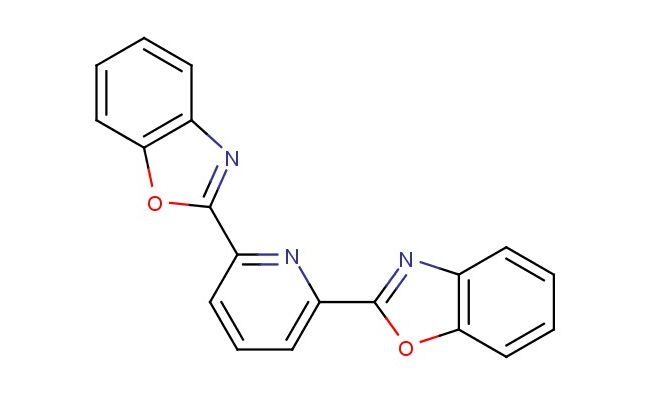
2,6-bis(benzo[d]oxazol-2-yl)pyridine
$380.00
CAS No.: 33858-36-5
Catalog No.: 196173
Purity: 95%
MF: C19H11N3O2
MW: 313.316
Storage: 2-8 degree Celsius
SMILES: O1C(=NC2=C1C=CC=C2)C2=NC(=CC=C2)C=2OC1=C(N2)C=CC=C1
Catalog No.: 196173
Purity: 95%
MF: C19H11N3O2
MW: 313.316
Storage: 2-8 degree Celsius
SMILES: O1C(=NC2=C1C=CC=C2)C2=NC(=CC=C2)C=2OC1=C(N2)C=CC=C1
For R&D use only. Not for human or veterinary use.
![1,3-bis(benzo[d]oxazol-2-yl)benzene](https://www.chemshuttle.com/media/catalog/product/cache/eda3e020a548044183bce7a8a96486f8/1/9/196172_2.jpg)
![3-(Benzo[d]oxazol-2-yl)-7-(diethylamino)-2H-chromen-2-one](https://www.chemshuttle.com/media/catalog/product/cache/eda3e020a548044183bce7a8a96486f8/2/0/200375_2.jpg)
![2-(benzo[d]oxazol-2-yl)aniline](https://www.chemshuttle.com/media/catalog/product/cache/eda3e020a548044183bce7a8a96486f8/2/0/200470_8.jpg)
![2-(benzo[d]oxazol-2-ylamino)-5,6-dimethylpyrimidin-4(3H)-one](https://www.chemshuttle.com/media/catalog/product/cache/eda3e020a548044183bce7a8a96486f8/1/9/197739.jpg)
![2-(benzo[d]oxazol-2-yl)-1-phenylethan-1-one](https://www.chemshuttle.com/media/catalog/product/cache/eda3e020a548044183bce7a8a96486f8/1/9/196818.jpg)
2,6-bis(benzo[d]oxazol-2-yl)pyridine; CAS No.: 33858-36-5; 2,6-bis(benzo[d]oxazol-2-yl)pyridine. PROPERTIES: This compound features a 2,6-bis(benzo[d]oxazol-2-yl)pyridine structure, combining two benzo[d]oxazole groups attached to a pyridine ring at positions 2 and 6. It typically appears as a white to pale yellow crystalline solid with a molecular weight of approximately 372.3 g/mol (C22H14N4O2). The melting point ranges between 210-215 C, and it exhibits moderate solubility in polar organic solvents like DMSO and DMF while being sparingly soluble in water. Proper storage requires a tightly sealed container in a cool, dry place. Safety precautions include wearing appropriate PPE. It is classified as a skin and eye irritant (GHS07) with the hazard statement H315-H319. APPLICATIONS: 2,6-Bis(benzo[d]oxazol-2-yl)pyridine serves as a valuable intermediate in materials science and pharmaceutical research. Its 2,6-bis(benzo[d]oxazol-2-yl)pyridine structure provides a rigid, conjugated framework suitable for developing organic light-emitting diodes (OLEDs) and field-effect transistors. In medicinal chemistry, it is used to create bioactive molecules targeting nucleic acids and protein-protein interactions. The pyridine nitrogen can undergo metal coordination to form complexes with therapeutic potential. This compound also functions as a building block in the synthesis of fluorescent dyes and sensors, where the conjugated system contributes to fluorescence properties. Academic studies employ it as a model system in Organic Chemistry journals, focusing on the development of novel heterocyclic materials based on the 2,6-bis(benzo[d]oxazol-2-yl)pyridine scaffold.
Reviews
Write Your Own Review