


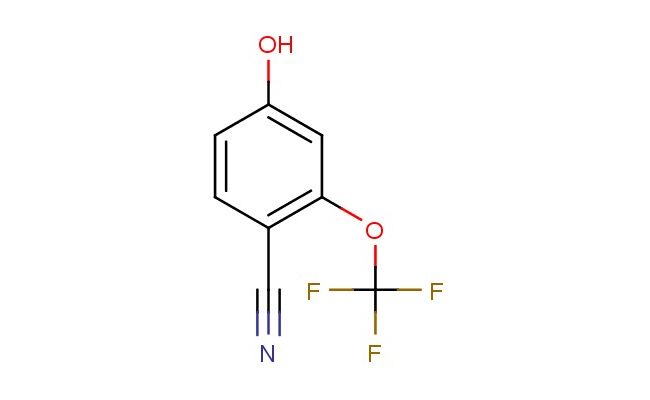


4-hydroxy-2-(trifluoromethoxy)benzonitrile
$250.00
CAS No.: 1261648-89-8
Catalog No.: 194068
Purity: 95%
MF: C8H4F3NO2
MW: 203.119
Storage: 2-8 degree Celsius
SMILES: OC1=CC(=C(C#N)C=C1)OC(F)(F)F
Catalog No.: 194068
Purity: 95%
MF: C8H4F3NO2
MW: 203.119
Storage: 2-8 degree Celsius
SMILES: OC1=CC(=C(C#N)C=C1)OC(F)(F)F
For R&D use only. Not for human or veterinary use.
4-hydroxy-2-(trifluoromethoxy)benzonitrile; CAS No.: 1261648-89-8; 4-hydroxy-2-(trifluoromethoxy)benzonitrile. PROPERTIES: 4-hydroxy-2-(trifluoromethoxy)benzonitrile appears as a white to off-white crystalline powder. Its molecular formula is C8H4F3NO3, and the molecular weight is approximately 227.12 g/mol. The compound has a melting point in the range of 85-87 C. It exhibits moderate solubility in polar organic solvents such as methanol and ethanol, but is relatively insoluble in non-polar solvents. For stable storage, it should be kept in a sealed container at 2-8 C, protected from moisture and light. Safety precautions include wearing protective eyewear, gloves, and a lab coat during handling. If the compound comes into contact with skin or eyes, thorough washing with water is required. In case of accidental ingestion, medical attention should be sought immediately. APPLICATIONS: In the pharmaceutical industry, 4-hydroxy-2-(trifluoromethoxy)benzonitrile can act as a key intermediate in the synthesis of certain drugs. The hydroxyl group can undergo etherification or esterification reactions, while the cyano group can be converted into functional groups such as carboxylic acid or amide. The trifluoromethoxy substituent provides unique lipophilic and electronic properties, which can be advantageous in the design of drugs with specific targeting and activity. For instance, it can be used in the development of anticancer drugs, where the substituents of 4-hydroxy-2-(trifluoromethoxy)benzonitrile can help improve the drug's ability to penetrate cancer cells and enhance its therapeutic effect (as reported in medicinal chemistry research articles). Moreover, in the field of bioactive molecule research, it can be employed as a building block for the synthesis of bioactive natural products or synthetic analogs, aiding in the discovery of new therapeutic agents (as mentioned in natural product chemistry journals).
Reviews
Write Your Own Review