


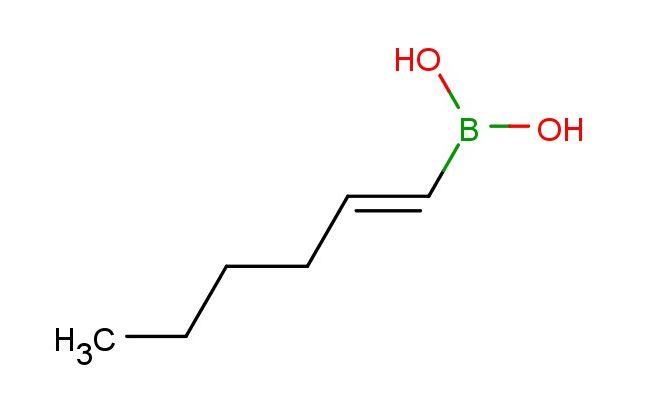


(E)-Hex-1-en-1-ylboronic acid
$400.00
CAS No.: 42599-18-8
Catalog No.: 196624
Purity: 95%
MF: C6H13BO2
MW: 127.98
Storage: 2-8 degree Celsius
SMILES: C(=C\CCCC)/B(O)O
Catalog No.: 196624
Purity: 95%
MF: C6H13BO2
MW: 127.98
Storage: 2-8 degree Celsius
SMILES: C(=C\CCCC)/B(O)O
For R&D use only. Not for human or veterinary use.
(E)-Hex-1-en-1-ylboronic acid; CAS No.: 42599-18-8; (E)-Hex-1-en-1-ylboronic acid. PROPERTIES: This alkenyl boronic acid features molecular formula C6H11BO2 with molecular weight 123.05 g/mol. It typically exists as colorless to pale yellow liquid, demonstrating characteristic reactivity of boronic acid and alkenyl functionalities. The compound shows good solubility in polar protic solvents like methanol and water, while being sparingly soluble in non-polar hydrocarbons. Its boiling point ranges between 110-115 C at 760 mmHg, and it exhibits IR absorption bands corresponding to the boronic acid group (~1200-1000 cm??) and alkenyl C=C stretch (~1650 cm??). Thermogravimetric analysis indicates decomposition onset above 150 C under nitrogen atmosphere. For optimal stability, (E)-Hex-1-en-1-ylboronic acid should be stored at 2-8 C in tightly sealed amber glass containers, protected from moisture and prolonged light exposure. As with boronic acids, it may form covalent bonds with Lewis bases; therefore, standard laboratory safety precautions including nitrile gloves, safety goggles, and proper ventilation are recommended during handling. APPLICATIONS: The conjugated alkenyl-boronic acid structure of (E)-Hex-1-en-1-ylboronic acid makes it valuable as a building block in Heck-type coupling reactions. It serves as a key intermediate in the preparation of conjugated dienes and polyenes, particularly in constructing pharmaceutical scaffolds where the boronic acid group facilitates carbon-carbon bond formation between alkenyl systems (Journal of Organic Chemistry). Additionally, the compound functions as a warhead in covalent inhibitor design, where it reacts with cysteine residues in target proteins as demonstrated in medicinal chemistry research (Bioorganic & Medicinal Chemistry Letters). The compound also finds utility in materials science as monomer for preparing polyboronic acid hydrogels with tunable mechanical properties, where its alkenyl group participates in free radical polymerization reactions (Macromolecular Materials and Engineering).
Reviews
Write Your Own Review