


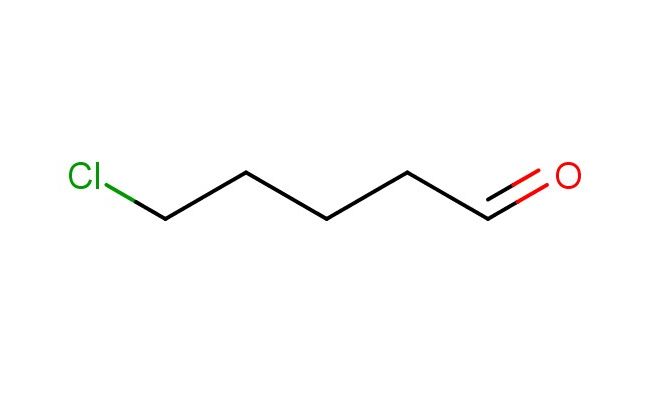


5-chloropentanal
$200.00
CAS No.: 20074-80-0
Catalog No.: 196729
Purity: 95%
MF: C5H9ClO
MW: 120.579
Storage: 2-8 degree Celsius
SMILES: ClCCCCC=O
Catalog No.: 196729
Purity: 95%
MF: C5H9ClO
MW: 120.579
Storage: 2-8 degree Celsius
SMILES: ClCCCCC=O
For R&D use only. Not for human or veterinary use.
5-chloropentanal; CAS No.: 20074-80-0; 5-chloropentanal. PROPERTIES: This chlorinated pentanal features molecular formula C?H?ClO? with molecular weight 133.58 g/mol. It typically exists as a colorless liquid. Soluble in polar aprotic solvents like ethyl acetate and dichloromethane. Boiling point approximately 120-125 C. Exhibits IR absorption for aldehyde (~2800-2600 cm??) and C-Cl groups (~600-500 cm??). Thermogravimetric analysis indicates decomposition above 150 C under nitrogen. For optimal stability, 5-chloropentanal should be stored at 2-8 C in tightly sealed amber glass containers, protected from moisture and prolonged light exposure. As with aldehyde compounds, it may cause severe skin burns and eye damage; therefore, rigorous containment and personal protection measures are essential during manipulation. APPLICATIONS: As a chlorinated aldehyde, 5-chloropentanal is particularly effective as a building block in agrochemical synthesis. It serves as a key intermediate in constructing pyrazoline herbicides, where the aldehyde group undergoes cyclization reactions to form the characteristic five-membered heterocycle (Pest Management Science). Additionally, the compound participates in the synthesis of fluorescent probes for bioimaging applications, where its aldehyde functionality enables conjugation to primary amines in biomolecules via Schiff base formation (Bioconjugate Chemistry). In materials science, it functions as a monomer for preparing polyurethane foams with enhanced thermal stability, where the chloro substituent contributes to improved flame retardancy and mechanical properties (Polymer International). Furthermore, the compound serves as a starting material in the development of aldehyde-based crosslinking agents for protein immobilization, where its reactive aldehyde group forms covalent bonds with amine-containing surfaces (ACS Applied Materials & Interfaces).
Reviews
Write Your Own Review