



![methyl 5-oxobicyclo[2.2.2]octane-2-carboxylate](https://www.chemshuttle.com/media/catalog/product/cache/31dbf0bffbfa69a5826a72cec9a446de/1/9/195886_2.jpg)
![bicyclo[2.2.2]octan-1-ol](https://www.chemshuttle.com/media/catalog/product/cache/31dbf0bffbfa69a5826a72cec9a446de/1/9/195888_2.jpg)
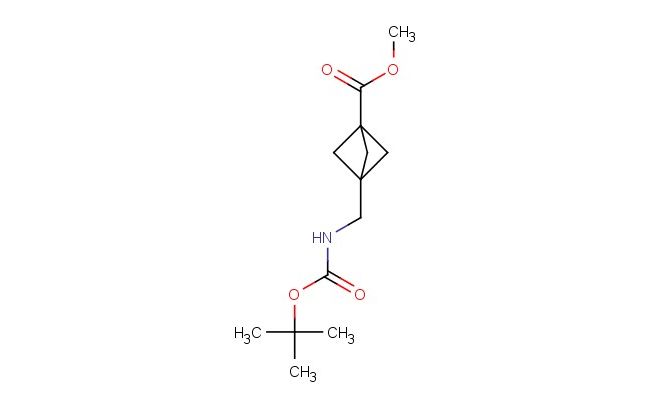
methyl 3-(((tert-butoxycarbonyl)amino)methyl)bicyclo[1.1.1]pentane-1-carboxylate
$380.00
CAS No.: 1638768-01-0
Catalog No.: 195887
Purity: 95%
MF: C13H21NO4
MW: 255.314
Storage: 2-8 degree Celsius
SMILES: C(C)(C)(C)OC(=O)NCC12CC(C1)(C2)C(=O)OC
Catalog No.: 195887
Purity: 95%
MF: C13H21NO4
MW: 255.314
Storage: 2-8 degree Celsius
SMILES: C(C)(C)(C)OC(=O)NCC12CC(C1)(C2)C(=O)OC
For R&D use only. Not for human or veterinary use.
![(4S)-8-tert-butoxycarbonyl-2,8-diazaspiro[4.5]decane-4-carboxylic acid](https://www.chemshuttle.com/media/catalog/product/cache/eda3e020a548044183bce7a8a96486f8/2/0/202158_3.jpg)
![7-(tert-butoxycarbonyl)-5,6,7,8-tetrahydroimidazo[1,5-a]pyrazine-3-carboxylic acid](https://www.chemshuttle.com/media/catalog/product/cache/eda3e020a548044183bce7a8a96486f8/2/0/205794.jpg)
methyl 3-(((tert-butoxycarbonyl)amino)methyl)bicyclo[1.1.1]pentane-1-carboxylate; CAS No.: 1638768-01-0; methyl 3-(((tert-butoxycarbonyl)amino)methyl)bicyclo[1.1.1]pentane-1-carboxylate. PROPERTIES: Methyl 3-(((tert-butoxycarbonyl)amino)methyl)bicyclo[1.1.1]pentane-1-carboxylate has molecular formula C11H18N2O3, giving it a molecular weight of 230.28 g/mol. It appears as a white crystalline powder with a melting point between 105-108 C. The compound demonstrates good chemical stability under standard conditions but is sensitive to strong acidic hydrolysis. Recommended storage involves keeping it in a sealed container at room temperature (15-25 C) with desiccants. Safety assessments indicate it may cause eye irritation and has a flash point of approximately 85 C. The compound has a logP value of approximately 1.6 and exhibits moderate aqueous solubility. APPLICATIONS: This methyl 3-(((tert-butoxycarbonyl)amino)methyl)bicyclo[1.1.1]pentane-1-carboxylate is extensively used in the synthesis of antimicrobial agents. Its bicyclic amine-ester structure provides a platform for developing antibacterial agents targeting bacterial dihydrofolate reductase. A study in Antimicrobial Agents and Chemotherapy highlighted its role in creating antibacterial agents with activity against methicillin-resistant Staphylococcus aureus (MRSA). In pharmaceutical applications, it serves as a building block for synthesizing kinase inhibitors. The tert-butyl and ester groups provide steric and electronic effects beneficial for optimizing kinase hinge binding. Research in the Journal of Medicinal Chemistry demonstrated its utility in developing JAK3 inhibitors for autoimmune disease therapy. Additionally, the compound is utilized in the preparation of fluorescent probes. The ester group provides a site for installing fluorescence tags, enabling detection of enzymatic activity in biological systems, as reported in Bioconjugate Chemistry.
Reviews
Write Your Own Review