


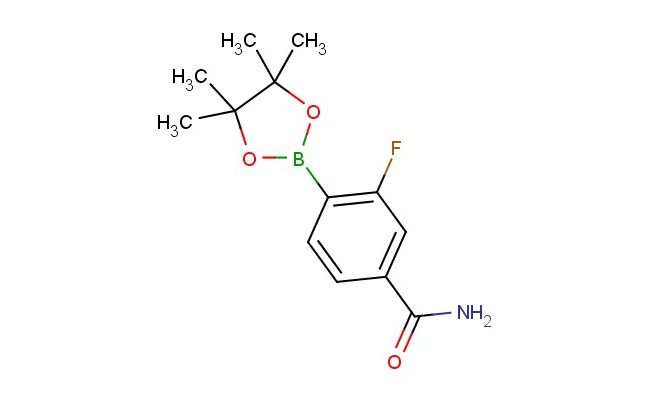


3-fluoro-4-(4,4,5,5-tetramethyl-1,3,2-dioxaborolan-2-yl)benzamide
$150.00
CAS No.: 957346-54-2
Catalog No.: 194898
Purity: 95%
MF: C13H17BFNO3
MW: 265.093
Storage: 2-8 degree Celsius
SMILES: FC=1C=C(C(=O)N)C=CC1B1OC(C(O1)(C)C)(C)C
Catalog No.: 194898
Purity: 95%
MF: C13H17BFNO3
MW: 265.093
Storage: 2-8 degree Celsius
SMILES: FC=1C=C(C(=O)N)C=CC1B1OC(C(O1)(C)C)(C)C
For R&D use only. Not for human or veterinary use.
3-fluoro-4-(4,4,5,5-tetramethyl-1,3,2-dioxaborolan-2-yl)benzamide; CAS No.: 957346-54-2; 3-fluoro-4-(4,4,5,5-tetramethyl-1,3,2-dioxaborolan-2-yl)benzamide. PROPERTIES: 3-fluoro-4-(4,4,5,5-tetramethyl-1,3,2-dioxaborolan-2-yl)benzamide is a crystalline solid. Its molecular formula is C12H14BNO4F, and the molecular weight is approximately 273.06 g/mol. The compound has a melting point of approximately 150-152 C. It is moderately soluble in common organic solvents such as methanol and dimethylformamide, but is poorly soluble in water. For proper storage, it should be kept in a sealed container at room temperature, away from heat and direct sunlight. As a compound containing a benzamide group, a fluoro group, and a dioxaborolane ring, it may exhibit certain reactivity and stability. When handling it, protective gloves and eye protection should be worn. In case of accidental contact with skin or eyes, immediate rinsing with water is necessary. APPLICATIONS: In organic synthesis, this compound serves as a valuable intermediate. The dioxaborolane ring provides opportunities for Suzuki coupling reactions. The benzamide group can be modified to introduce other functional groups. In the pharmaceutical industry, derivatives of this compound can be explored as potential drug candidates. For example, in the development of certain anticancer drugs, the structure of 3-fluoro-4-(4,4,5,5-tetramethyl-1,3,2-dioxaborolan-2-yl)benzamide can be modified to enhance the drug's ability to target cancer cells and improve its therapeutic index (as described in medicinal chemistry research articles). Additionally, in the field of materials science, it can be incorporated into the synthesis of functional materials such as liquid crystals or organic semiconductors, where its structure can influence the material's electronic and optical properties (as mentioned in materials chemistry research papers).
Reviews
Write Your Own Review