


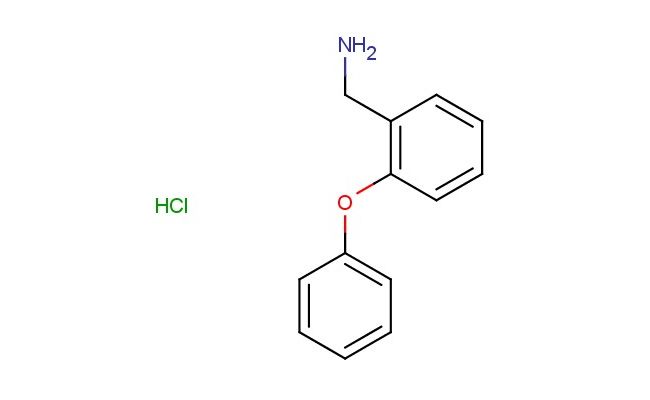


(2-phenoxyphenyl)methanamine hydrochloride
$300.00
CAS No.: 31963-35-6
Catalog No.: 196503
Purity: 95%
MF: C13H14ClNO
MW: 235.714
Storage: 2-8 degree Celsius
SMILES: Cl.O(C1=CC=CC=C1)C1=C(C=CC=C1)CN
Catalog No.: 196503
Purity: 95%
MF: C13H14ClNO
MW: 235.714
Storage: 2-8 degree Celsius
SMILES: Cl.O(C1=CC=CC=C1)C1=C(C=CC=C1)CN
For R&D use only. Not for human or veterinary use.
(2-phenoxyphenyl)methanamine hydrochloride; CAS No.: 31963-35-6; (2-phenoxyphenyl)methanamine hydrochloride. PROPERTIES: (2-phenoxyphenyl)methanamine hydrochloride appears as a white to off-white crystalline powder. Its molecular formula is C13H13NO.HCl, corresponding to a molecular weight of 233.7 g/mol. The compound is highly soluble in water and polar organic solvents such as methanol and ethanol. It has a melting point typically ranging from 180-185 C and is stable under normal laboratory conditions when stored properly. Recommended storage involves keeping the material in a tightly sealed container at room temperature (15-25 C), preferably in a cool, dry, and well-ventilated area away from direct sunlight and moisture. The compound is hygroscopic and should be protected from excessive humidity. Safety precautions include wearing appropriate personal protective equipment such as chemical-resistant gloves and eye protection when handling the material. In case of skin contact, thorough washing with water is recommended, and eye contact requires immediate rinsing with water for at least 15 minutes followed by medical attention if necessary. The compound should be handled in well-ventilated areas to minimize inhalation risks. APPLICATIONS: (2-phenoxyphenyl)methanamine hydrochloride serves as a valuable building block in pharmaceutical chemistry, particularly in the development of novel antidepressants and anxiolytics. The presence of the phenoxyphenyl and amine groups provides versatile sites for further functionalization and bioisosteric replacements. In medicinal chemistry research, the compound has been utilized as a core structure in the synthesis of adrenergic receptor modulators and as a starting material for the development of antipsychotic agents, as reported in various pharmaceutical research publications. The methanamine framework offers a suitable platform for the design of bioactive molecules with improved blood-brain barrier penetration and target specificity. Additionally, (2-phenoxyphenyl)methanamine hydrochloride finds application in materials science as a building block for organic electrochemical transistors and in the development of fluorescent probes for bioimaging applications. Its utility extends to analytical chemistry, where it serves as a reference standard for chromatographic analyses and as a starting material for custom syntheses in specialized laboratories focusing on heterocyclic chemistry and medicinal applications. The compound's structural features make it suitable for incorporation into molecular sensors and as a component in luminescent materials for optical devices.
Reviews
Write Your Own Review