


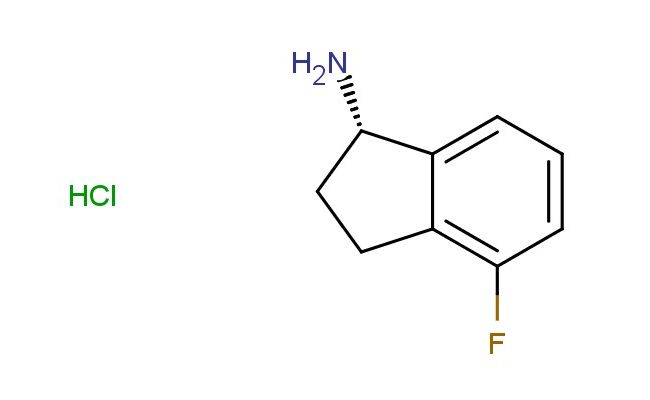


(S)-4-fluoro-2,3-dihydro-1H-inden-1-amine hydrochloride
$200.00
CAS No.: 1286734-90-4
Catalog No.: WLZ0461
Purity: 95%
MF: C9H11ClFN
MW: 187.645
Storage: 2-8 degree Celsius
SMILES: Cl.FC1=C2CC[C@@H](C2=CC=C1)N
Catalog No.: WLZ0461
Purity: 95%
MF: C9H11ClFN
MW: 187.645
Storage: 2-8 degree Celsius
SMILES: Cl.FC1=C2CC[C@@H](C2=CC=C1)N
For R&D use only. Not for human or veterinary use.
![4-fluoro-2,3-dihydrospiro[indene-1,3'-piperidine] hydrochloride](https://www.chemshuttle.com/media/catalog/product/cache/eda3e020a548044183bce7a8a96486f8/1/6/163332_1.jpg)
CAS NO.: 1286734-90-4; (S)-4-fluoro-2,3-dihydro-1H-inden-1-amine hydrochloride. PROPERTIES: (S)-4-fluoro-2,3-dihydro-1H-inden-1-amine hydrochloride presents as white crystalline powder with a characteristic amine odor. Its molecular formula is C9H10FNN HCl, corresponding to a molecular weight of 201.64 g/mol. The compound has a melting point between 198-202 C and is highly soluble in water, forming clear, slightly exothermic solutions. Proper storage requires temperatures between 2-8 degree Celsius in glass containers with desiccants to prevent moisture-induced degradation. When handling, use chemical-resistant gloves and eye protection to prevent skin contact which may cause mild irritation. The substance is stable under dry conditions but undergoes hydrolysis in basic environments, releasing the corresponding amine and hydrochloric acid. It is classified as a mild irritant and requires careful handling to prevent exposure. The hydrochloride salt form enhances water solubility, facilitating formulation development for injectable products. The compound exhibits moderate hygroscopicity and should be protected from prolonged exposure to atmospheric moisture. APPLICATIONS: (S)-4-fluoro-2,3-dihydro-1H-inden-1-amine hydrochloride functions as a key intermediate in the synthesis of serotonin-norepinephrine reuptake inhibitors (SNRIs). The fluorine substituent at position 4 provides electronic effects that modulate the compound's interactions with neurotransmitter transporters. The (S)-configuration ensures proper orientation within the binding pocket, maximizing inhibitory activity against the targeted transporters. In medicinal chemistry, this compound is used to develop antidepressant agents where the indane scaffold provides optimal interactions with both serotonin and norepinephrine transporters. The amine group allows for further functionalization, enabling the creation of prodrugs with improved bioavailability. Researchers in neuropharmacology utilize this compound to create selective serotonin reuptake inhibitors (SSRIs) with reduced side effect profiles. The compound serves as a building block for synthesizing tritiated ligands used in receptor binding assays to determine the affinity and selectivity of new drug candidates. Additionally, derivatives of this compound are employed in the development of anxiolytic agents where the indane core contributes to anxiolytic effects through interactions with specific GABA receptor subtypes. The hydrochloride salt form ensures good solubility, making it suitable for preclinical pharmacokinetic studies. The compound's structural features make it suitable for use in combinatorial chemistry approaches, where its versatile reactivity allows for the rapid generation of diverse compound libraries. It also functions as a chiral amine component in asymmetric catalysis, directing the enantioselective outcomes of various carbon-carbon bond-forming reactions.
Reviews
Write Your Own Review