


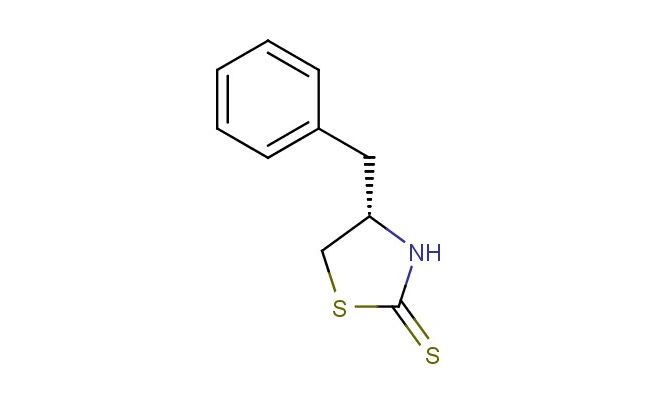


(S)-4-benzylthiazolidine-2-thione
$200.00
CAS No.: 171877-39-7
Catalog No.: WLZ1565
Purity: 95%
MF: C10H11NS2
MW: 209.339
Storage: 2-8 degree Celsius
SMILES: C(C1=CC=CC=C1)[C@@H]1NC(SC1)=S
Catalog No.: WLZ1565
Purity: 95%
MF: C10H11NS2
MW: 209.339
Storage: 2-8 degree Celsius
SMILES: C(C1=CC=CC=C1)[C@@H]1NC(SC1)=S
For R&D use only. Not for human or animal use.
![3-(4-benzylpiperidin-1-yl)-1-(7-methoxy-2,3-dihydrobenzo[f][1,4]thiazepin-4(5H)-yl)propan-1-one](https://www.chemshuttle.com/media/catalog/product/cache/eda3e020a548044183bce7a8a96486f8/t/q/tqr0296_2.jpg)
CAS NO.: 171877-39-7; (S)-4-benzylthiazolidine-2-thione. PROPERTIES: This chiral thiazolidine derivative features a benzyl group and a thione functionality in a thiazolidine ring, creating a molecule with potential applications in medicinal chemistry and pharmaceutical research. The (S)-4-benzylthiazolidine-2-thione typically appears as a white to off-white crystalline solid with limited aqueous solubility but good solubility in polar aprotic solvents. Its molecular architecture includes a chiral center at the 4-position of the thiazolidine ring, which is critical for maintaining stereochemical integrity during synthetic applications. For optimal stability and to preserve its structural integrity, this compound should be stored at 2-8 degree Celsius in a desiccator under anhydrous conditions. When handling, researchers should employ standard laboratory safety practices including nitrile gloves and a lab coat. This compound is hygroscopic and may degrade upon exposure to moisture. In case of skin contact, wash thoroughly with soap and water; if eye contact occurs, rinse immediately and seek medical advice. APPLICATIONS: The (S)-4-benzylthiazolidine-2-thione serves as a valuable building block in peptide synthesis and medicinal chemistry, particularly for creating bioactive molecules with specific stereochemistry. The thiazolidine ring provides a platform for developing enzyme inhibitors and receptor modulators with defined chiral properties. In pharmaceutical development, this compound functions as a starting material for synthesizing antiviral and anticancer agents where the thiazolidine scaffold contributes to target engagement. Additionally, the molecule finds utility in chemical biology studies where its unique scaffold can be used to probe enzyme inhibition mechanisms and cellular signaling pathways. Researchers utilizing this compound benefit from its defined stereochemistry and functional group arrangement, advancing investigations into novel therapeutic approaches for various disease conditions.
Reviews
Write Your Own Review