



![4-chloro-1-methyl-1H-pyrrolo[2,3-b]pyridine](https://www.chemshuttle.com/media/catalog/product/cache/31dbf0bffbfa69a5826a72cec9a446de/1/9/196490_2.jpg)
![4-chloro-5-fluoro-1H-pyrrolo[2,3-b]pyridine](https://www.chemshuttle.com/media/catalog/product/cache/31dbf0bffbfa69a5826a72cec9a446de/1/1/113589_5.jpg)
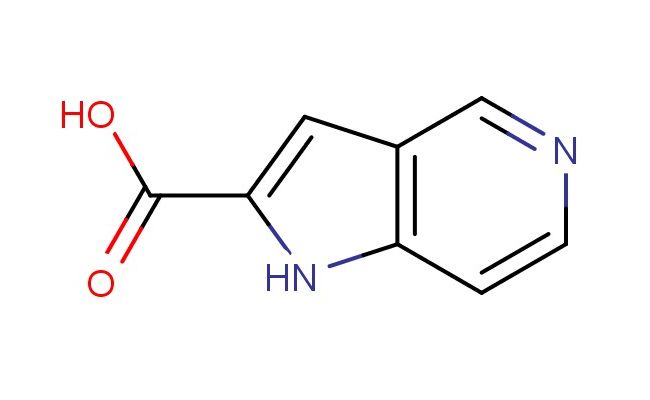
1H-pyrrolo[3,2-c]pyridine-2-carboxylic acid
$300.00
CAS No.: 800401-65-4
Catalog No.: 196493
Purity: 95%
MF: C8H6N2O2
MW: 162.148
Storage: 2-8 degree Celsius
SMILES: N1C(=CC=2C=NC=CC21)C(=O)O
Catalog No.: 196493
Purity: 95%
MF: C8H6N2O2
MW: 162.148
Storage: 2-8 degree Celsius
SMILES: N1C(=CC=2C=NC=CC21)C(=O)O
For R&D use only. Not for human or veterinary use.
![(1-tosyl-1H-pyrrolo[2,3-b]pyridin-2-yl)boronic acid](https://www.chemshuttle.com/media/catalog/product/cache/eda3e020a548044183bce7a8a96486f8/1/9/199376_1.jpg)
![diethyl 1H-pyrrolo[2,3-b]pyridine-2,6-dicarboxylate](https://www.chemshuttle.com/media/catalog/product/cache/eda3e020a548044183bce7a8a96486f8/z/b/zb2126.jpg)
![(1-tert-butoxycarbonylpyrrolo[2,3-c]pyridin-2-yl)boronic acid](https://www.chemshuttle.com/media/catalog/product/cache/eda3e020a548044183bce7a8a96486f8/w/l/wlz1208_2.jpg)
1H-pyrrolo[3,2-c]pyridine-2-carboxylic acid; CAS No.: 800401-65-4; 1H-pyrrolo[3,2-c]pyridine-2-carboxylic acid. PROPERTIES: 1H-pyrrolo[3,2-c]pyridine-2-carboxylic acid appears as a white to off-white crystalline powder. Its molecular formula is C9H6N2O2, corresponding to a molecular weight of 178.15 g/mol. The compound demonstrates moderate solubility in polar solvents such as water, methanol, and ethyl acetate, but limited solubility in non-polar solvents. It has a melting point typically ranging from 220-225 C and is stable under normal laboratory conditions when stored properly. Recommended storage involves keeping the material in a tightly sealed container at room temperature (15-25 C), preferably in a cool, dry, and well-ventilated area away from direct sunlight and moisture. The compound is hygroscopic to some extent and should be protected from excessive humidity. Safety precautions include wearing appropriate personal protective equipment such as chemical-resistant gloves and eye protection when handling the material. In case of skin contact, washing with soap and water is advised, and eye contact requires thorough rinsing with water for at least 15 minutes followed by medical attention if irritation persists. The compound should be handled in well-ventilated areas to avoid inhalation of dust particles. APPLICATIONS: 1H-pyrrolo[3,2-c]pyridine-2-carboxylic acid serves as a versatile building block in organic synthesis, particularly valuable in the development of bioactive molecules and pharmaceutical intermediates. Its unique carboxylic acid functionality provides a reactive site for esterification, amide formation, and other coupling reactions. In medicinal chemistry, the compound has been utilized as a starting material for the synthesis of novel nonsteroidal anti-inflammatory agents and as a core structure in the design of matrix metalloproteinase inhibitors, as reported in several pharmaceutical research journals. The pyrrolopyridine framework offers a suitable platform for the development of enzyme inhibitors with improved selectivity and potency. Additionally, 1H-pyrrolo[3,2-c]pyridine-2-carboxylic acid finds application in materials science as a building block for organic semiconductors and in the development of fluorescent probes for bioimaging applications. Its utility extends to analytical chemistry, where it serves as a reference compound for spectral databases and as a starting material for custom syntheses in specialized laboratories focusing on heterocyclic chemistry and medicinal applications. The compound's structural features make it suitable for incorporation into peptide mimetics and as a component in molecular sensors for ion detection.
Reviews
Write Your Own Review