



![6-bromo-2-methyloxazolo[4,5-b]pyridine](https://www.chemshuttle.com/media/catalog/product/cache/31dbf0bffbfa69a5826a72cec9a446de/1/9/196120_2.jpg)
![6-bromo-2-(6-methylpyrimidin-4-yl)oxazolo[5,4-b]pyridine](https://www.chemshuttle.com/media/catalog/product/cache/31dbf0bffbfa69a5826a72cec9a446de/2/0/200849_2.jpg)
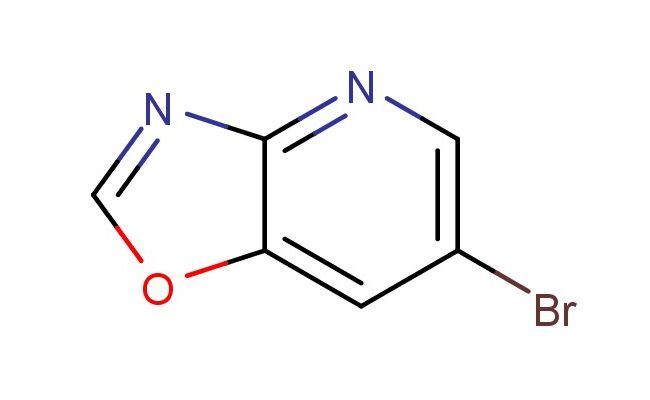
6-bromooxazolo[4,5-b]pyridine
$300.00
CAS No.: 1260863-86-2
Catalog No.: 196121
Purity: 95%
MF: C6H3BrN2O
MW: 199.007
Storage: 2-8 degree Celsius
SMILES: BrC=1C=C2C(=NC1)N=CO2
Catalog No.: 196121
Purity: 95%
MF: C6H3BrN2O
MW: 199.007
Storage: 2-8 degree Celsius
SMILES: BrC=1C=C2C(=NC1)N=CO2
For R&D use only. Not for human or veterinary use.
6-bromooxazolo[4,5-b]pyridine; CAS No.: 1260863-86-2; 6-bromooxazolo[4,5-b]pyridine. PROPERTIES: This crystalline solid has a molecular formula of C7H4BrN2O and a molecular weight of approximately 213.03 g/mol. It demonstrates low water solubility but dissolves in DMSO and DMF. The compound is sensitive to basic conditions and should be stored in a tightly sealed container at room temperature, protected from moisture. Thermal decomposition occurs above 200 C. Safety guidelines recommend using chemical splash goggles, lab coats, and NIOSH-certified respirators. In case of skin contact, wash with soap and water and remove contaminated clothing. Avoid inhaling dust as it may cause respiratory irritation. Do not release to the environment as brominated heterocycles may affect aquatic organisms. APPLICATIONS: 6-bromooxazolo[4,5-b]pyridine serves as a key intermediate in pharmaceutical synthesis, particularly in the development of kinase inhibitors. Its oxazolopyridine core forms the basis of several clinical candidates targeting oncology indications. The bromine substituent enables palladium-catalyzed cross-coupling reactions for creating diverse substituent patterns. Research groups employ it in covalent inhibitor design due to the electrophilic nature of the oxazole ring. Academic institutions utilize it in structure-activity relationship (SAR) studies to understand substituent effects on binding affinity. Industrial applications include its use as a building block in agrochemical development for novel herbicide candidates. Recent publications in Bioorganic & Medicinal Chemistry highlight its role in developing dual kinase/HDAC inhibitors. Additionally, it finds utility in chemical biology as a warhead for activity-based protein profiling probes. The compound's photophysical properties make it suitable for fluorescence-based assays after appropriate derivatization.
Reviews
Write Your Own Review