


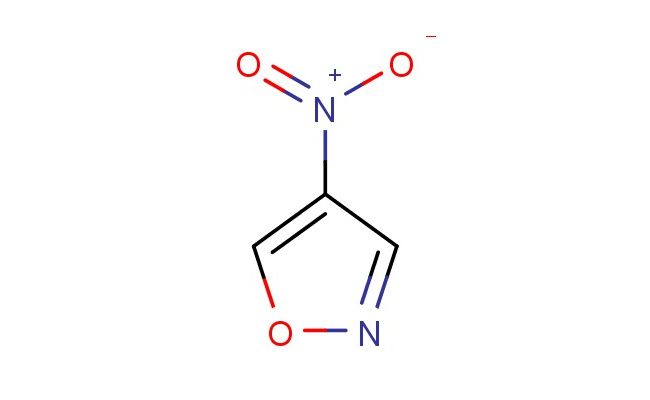


4-nitroisoxazole
$300.00
CAS No.: 1121-13-7
Catalog No.: 196150
Purity: 95%
MF: C3H2N2O3
MW: 114.06
Storage: 2-8 degree Celsius
SMILES: [N+](=O)([O-])C=1C=NOC1
Catalog No.: 196150
Purity: 95%
MF: C3H2N2O3
MW: 114.06
Storage: 2-8 degree Celsius
SMILES: [N+](=O)([O-])C=1C=NOC1
For R&D use only. Not for human or veterinary use.
![3-nitro-5-methylimidazo[1,2-a]pyridine](https://www.chemshuttle.com/media/catalog/product/cache/eda3e020a548044183bce7a8a96486f8/w/l/wlz2646_1.jpg)
4-nitroisoxazole; CAS No.: 1121-13-7; 4-nitroisoxazole. PROPERTIES: This white to off-white crystalline powder has a molecular formula of C3H2N2O3 and a molecular weight of approximately 114.06 g/mol. It exhibits moderate solubility in water and common polar solvents. The compound is sensitive to basic conditions and should be stored in a tightly sealed container at room temperature. Thermogravimetric analysis shows decomposition starting at 150 C with potential formation of toxic nitrogen oxides. Safety guidelines recommend using chemical-resistant gloves, face shields, and working in a fume hood. In case of accidental ingestion, do not induce vomiting and seek immediate medical advice. Avoid release to the environment as nitro-containing compounds may affect aquatic organisms. APPLICATIONS: 4-nitroisoxazole serves as a valuable intermediate in pharmaceutical synthesis and materials science. Its isoxazole core provides a bioisosteric replacement opportunity for oxygen-containing heterocycles. The nitro group enables reduction to amine derivatives for further functionalization. Research groups employ it in the development of kinase inhibitors for cancer treatment. Academic institutions utilize it in teaching nitro chemistry and redox reactions. Industrial applications include its use as a building block in agrochemical development for novel herbicide candidates and as a component of organic photovoltaic materials due to its strong electron-withdrawing properties. Recent publications in the Journal of Organic Chemistry highlight its role in domino reaction sequences for complex molecule synthesis. Additionally, it finds utility in chemical biology as a warhead for covalent inhibitors targeting protein kinases. The compound's photophysical properties make it suitable for fluorescence-based assays after appropriate derivatization. Its ability to form hydrogen bonds enhances its utility in crystallographic studies of protein-ligand complexes.
Reviews
Write Your Own Review