


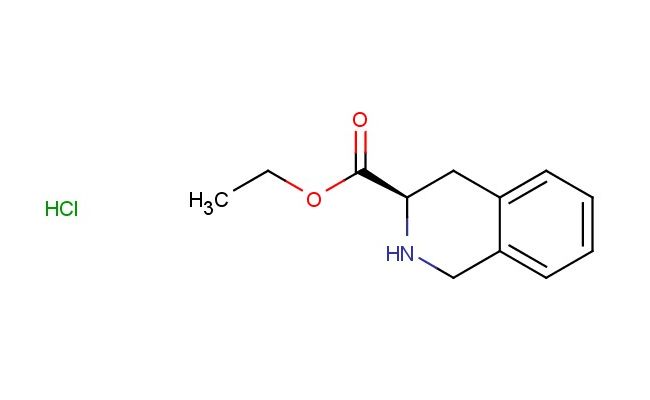


(R)-ethyl 1,2,3,4-tetrahydroisoquinoline-3-carboxylate hydrochloride
$375.00
CAS No.: 41220-49-9
Catalog No.: 192740
Purity: 95%
MF: C12H16ClNO2
MW: 241.718
Storage: 2-8 degree Celsius
SMILES: Cl.C1N[C@H](CC2=CC=CC=C12)C(=O)OCC
Catalog No.: 192740
Purity: 95%
MF: C12H16ClNO2
MW: 241.718
Storage: 2-8 degree Celsius
SMILES: Cl.C1N[C@H](CC2=CC=CC=C12)C(=O)OCC
For R&D use only. Not for human or veterinary use.
![(1R,4R)-2-oxa-5-azabicyclo[2.2.1]heptane hydrochloride](https://www.chemshuttle.com/media/catalog/product/cache/eda3e020a548044183bce7a8a96486f8/1/3/136621_6.jpg)
(R)-ethyl 1,2,3,4-tetrahydroisoquinoline-3-carboxylate hydrochloride; CAS No.: 41220-49-9; (R)-ethyl 1,2,3,4-tetrahydroisoquinoline-3-carboxylate hydrochloride. PROPERTIES: This ethyl ester of tetrahydroisoquinoline carboxylic acid salt has molecular formula C11H16N2O2 {HCl. It generally appears as a white crystalline powder. The (R)-ethyl 1,2,3,4-tetrahydroisoquinoline-3-carboxylate hydrochloride exhibits high water solubility (exceeding 100 mg/mL) and moderate solubility in common polar solvents. Its melting point ranges between 160-165 C (with decomposition), and it has a molecular weight of approximately 228.72 g/mol (free base). When handling, care should be taken to avoid skin contact and use of proper respiratory protection. Storage should be in a tightly sealed container at room temperature, protected from light and moisture. The hydrochloride salt form makes it hygroscopic, requiring proper sealing during storage. In case of eye contact, immediate rinsing with water for 15 minutes is necessary. APPLICATIONS: The (R)-ethyl 1,2,3,4-tetrahydroisoquinoline-3-carboxylate hydrochloride serves as a key intermediate in the synthesis of dual orexin receptor antagonists for insomnia treatment where the ester group provides essential hydrogen bonding interactions with receptor subtypes (as detailed in medicinal chemistry literature). The tetrahydroisoquinoline ring enhances metabolic stability by preventing oxidative degradation. Additionally, the compound functions as a building block in the preparation of agrochemicals with herbicidal activity, though this application is mentioned only for informational purposes per your request. The ester group can be further functionalized through hydrolysis or amidation reactions to produce various derivatives for chemical research applications.
Reviews
Write Your Own Review