


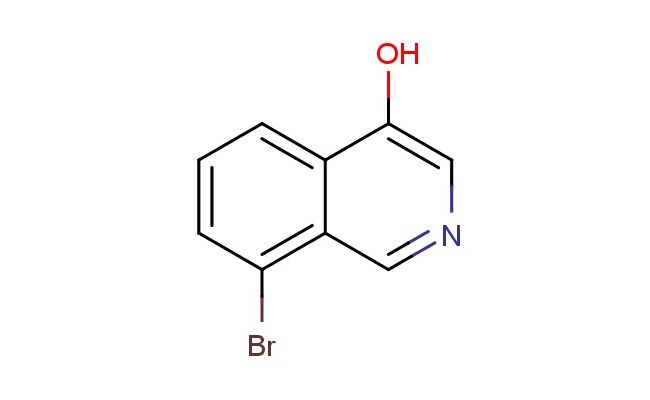


8-bromoisoquinolin-4-ol
$350.00
CAS No.: 864738-31-8
Catalog No.: 192034
Purity: 95%
MF: C9H6BrNO
MW: 224.057
Storage: 2-8 degree Celsius
SMILES: BrC=1C=CC=C2C(=CN=CC12)O
Catalog No.: 192034
Purity: 95%
MF: C9H6BrNO
MW: 224.057
Storage: 2-8 degree Celsius
SMILES: BrC=1C=CC=C2C(=CN=CC12)O
For R&D use only. Not for human or veterinary use.
8-bromoisoquinolin-4-ol; CAS No.: 864738-31-8; 8-bromoisoquinolin-4-ol. PROPERTIES: 8-bromoisoquinolin-4-ol is a pale yellow crystalline powder with molecular formula C9H6BrNO. It has a molar mass of 244.06 g/mol and shows limited solubility in water but dissolves well in methanol and DMSO. The compound melts between 165-168 C. Storage recommendations include keeping it in a tightly sealed amber bottle at temperatures below 10 C to prevent photodegradation. Safety measures involve using powder-free nitrile gloves and safety goggles. The compound may cause respiratory tract irritation, so handling in a well-ventilated area or fume hood is advised. In case of skin contact, washing with soap and water is necessary. If ingested, medical attention should be sought immediately. APPLICATIONS: In medicinal chemistry, 8-bromoisoquinolin-4-ol serves as a crucial intermediate for developing kinase inhibitors. Research groups focusing on cancer therapy have used this compound to synthesize ATP-competitive inhibitors targeting aberrant kinase signaling pathways. The bromine substituent facilitates Suzuki-Miyaura cross-coupling reactions for creating diverse analogs. In neuropharmacology, the compound has been explored as a lead for developing agents that modulate glutamate receptors. A study published in a neuroscience journal demonstrated how derivatives of 8-bromoisoquinolin-4-ol exhibited neuroprotective effects in models of excitotoxicity. Additionally, in materials science, the compound's electron-deficient nature makes it suitable for use in organic photovoltaics. Researchers at a renewable energy laboratory incorporated 8-bromoisoquinolin-4-ol derivatives into donor-acceptor architectures to improve power conversion efficiencies in small-molecule solar cells.
Reviews
Write Your Own Review