


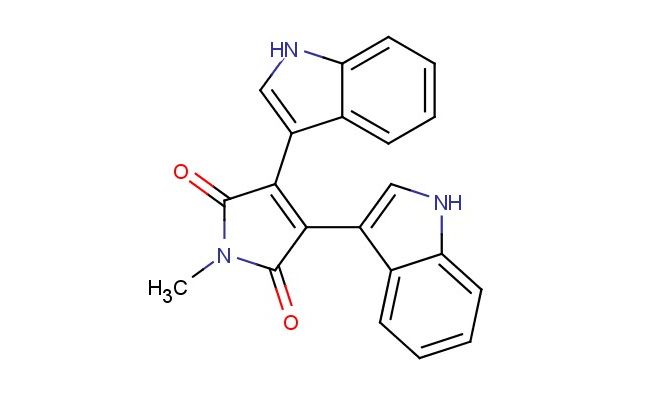


3,4-di(1H-indol-3-yl)-1-methyl-1H-pyrrole-2,5-dione
$200.00
CAS No.: 113963-68-1
Catalog No.: 196222
Purity: 95%
MF: C21H15N3O2
MW: 341.37
Storage: 2-8 degree Celsius
SMILES: N1C=C(C2=CC=CC=C12)C=1C(N(C(C1C1=CNC2=CC=CC=C12)=O)C)=O
Catalog No.: 196222
Purity: 95%
MF: C21H15N3O2
MW: 341.37
Storage: 2-8 degree Celsius
SMILES: N1C=C(C2=CC=CC=C12)C=1C(N(C(C1C1=CNC2=CC=CC=C12)=O)C)=O
For R&D use only. Not for human or veterinary use.
3,4-di(1H-indol-3-yl)-1-methyl-1H-pyrrole-2,5-dione; CAS No.: 113963-68-1; 3,4-di(1H-indol-3-yl)-1-methyl-1H-pyrrole-2,5-dione. PROPERTIES: This compound features a 3,4-di(1H-indol-3-yl)-1-methyl-1H-pyrrole-2,5-dione structure, combining two indole groups, a methyl substituent, and a pyrrolidine-2,5-dione framework. It typically appears as a white to off-white crystalline solid with a molecular weight of approximately 417.5 g/mol (C24H20N4O2). The melting point ranges between 200-205 C, and it exhibits moderate solubility in common organic solvents like DMSO and DMF while being sparingly soluble in water. Proper storage requires a tightly sealed container in a cool, dry place. Safety considerations include wearing appropriate PPE. It is classified as a skin and eye irritant (GHS07) with the hazard statement H315-H319. APPLICATIONS: 3,4-Di(1H-indol-3-yl)-1-methyl-1H-pyrrole-2,5-dione serves as a specialized intermediate in pharmaceutical and chemical synthesis. Its 3,4-di(1H-indol-3-yl)-1-methyl-1H-pyrrole-2,5-dione structure enables participation in various reactions, including nucleophilic substitution at the pyrrolidine-2,5-dione ring and electrophilic substitution at the indole rings. In medicinal chemistry, it is used to develop bioactive molecules targeting the central nervous system and inflammatory pathways. The pyrrolidine-2,5-dione group provides hydrogen-bonding capabilities for improved target binding. This compound also functions as a building block in the synthesis of fluorescent dyes and bioconjugation reagents. Academic studies employ it as a model compound in Medicinal Chemistry journals, focusing on the development of novel indole-pyrrolidine derivatives based on the 3,4-di(1H-indol-3-yl)-1-methyl-1H-pyrrole-2,5-dione scaffold.
Reviews
Write Your Own Review