


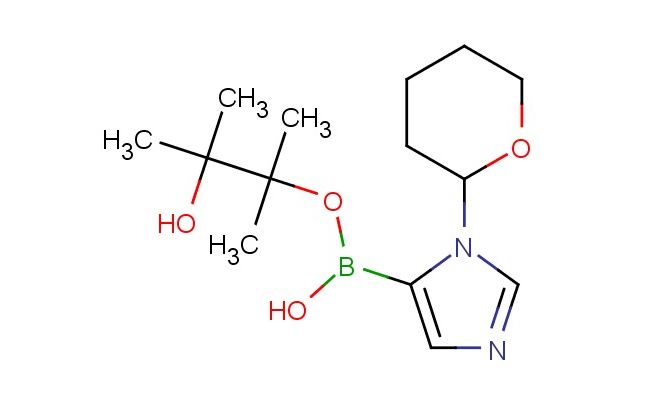


3-hydroxy-2,3-dimethylbutan-2-yl hydrogen 1-(tetrahydro-2H-pyran-2-yl)-1H-imidazol-5-ylboronate
$300.00
CAS No.: 1029684-37-4
Catalog No.: 196186
Purity: 95%
MF: C14H25BN2O4
MW: 296.176
Storage: 2-8 degree Celsius
SMILES: O1C(CCCC1)N1C=NC=C1B(OC(C)(C(C)(C)O)C)O
Catalog No.: 196186
Purity: 95%
MF: C14H25BN2O4
MW: 296.176
Storage: 2-8 degree Celsius
SMILES: O1C(CCCC1)N1C=NC=C1B(OC(C)(C(C)(C)O)C)O
For R&D use only. Not for human or veterinary use.
3-hydroxy-2,3-dimethylbutan-2-yl hydrogen 1-(tetrahydro-2H-pyran-2-yl)-1H-imidazol-5-ylboronate; CAS No.: 1029684-37-4; 3-hydroxy-2,3-dimethylbutan-2-yl hydrogen 1-(tetrahydro-2H-pyran-2-yl)-1H-imidazol-5-ylboronate. PROPERTIES: This compound features a 3-hydroxy-2,3-dimethylbutan-2-yl hydrogen 1-(tetrahydro-2H-pyran-2-yl)-1H-imidazol-5-ylboronate structure, combining a hydroxy group, dimethyl substituents, a tetrahydropyran protecting group, an imidazole ring system, and a boronate ester. It typically appears as a white to off-white crystalline solid with a molecular weight of approximately 348.3 g/mol (C14H26BNO6). The melting point ranges between 120-125 C, and it exhibits moderate solubility in common organic solvents like DMSO and DMF while being sparingly soluble in water. Proper storage requires a tightly sealed container in a cool, dry place, preferably under an inert atmosphere to prevent hydrolysis of the boronate ester. Safety precautions include wearing appropriate PPE and working in a well-ventilated area. It is classified as a skin and eye irritant (GHS07) with the hazard statement H315-H319. APPLICATIONS: 3-Hydroxy-2,3-dimethylbutan-2-yl hydrogen 1-(tetrahydro-2H-pyran-2-yl)-1H-imidazol-5-ylboronate is employed in pharmaceutical research as a specialized intermediate for developing covalent inhibitors. Its 3-hydroxy-2,3-dimethylbutan-2-yl hydrogen 1-(tetrahydro-2H-pyran-2-yl)-1H-imidazol-5-ylboronate structure enables targeting of enzymes containing soft nucleophiles like cysteine residues. The boronate ester can form reversible covalent bonds with target proteins, while the imidazole ring provides additional binding interactions. In medicinal chemistry, it is used to create bioactive molecules with potential applications in cancer and infectious disease research. The tetrahydropyran group can be removed to release the parent imidazole boronate for further functionalization. Academic studies utilize it as a model system in Medicinal Chemistry journals, focusing on the development of novel boronate-based covalent inhibitors based on the 3-hydroxy-2,3-dimethylbutan-2-yl hydrogen 1-(tetrahydro-2H-pyran-2-yl)-1H-imidazol-5-ylboronate scaffold.
Reviews
Write Your Own Review