



![6-bromo-5-fluorobenzo[d]oxazol-2-amine](https://www.chemshuttle.com/media/catalog/product/cache/31dbf0bffbfa69a5826a72cec9a446de/t/q/tqp0560_1.jpg)
![2-(4-fluorophenyl)benzo[d]oxazol-5-amine](https://www.chemshuttle.com/media/catalog/product/cache/31dbf0bffbfa69a5826a72cec9a446de/t/q/tqp2216_1.jpg)
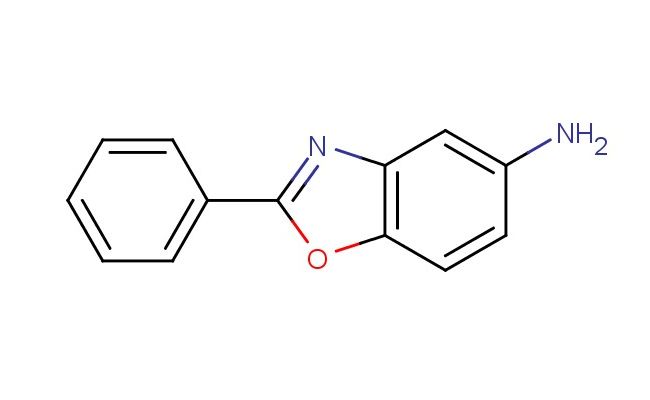
2-phenylbenzo[d]oxazol-5-amine
$200.00
CAS No.: 41373-37-9
Catalog No.: TQP2215
Purity: 95%
MF: C13H10N2O
MW: 210.236
Storage: 2-8 degree Celsius
SMILES: C1(=CC=CC=C1)C=1OC2=C(N1)C=C(C=C2)N
Catalog No.: TQP2215
Purity: 95%
MF: C13H10N2O
MW: 210.236
Storage: 2-8 degree Celsius
SMILES: C1(=CC=CC=C1)C=1OC2=C(N1)C=C(C=C2)N
For R&D use only. Not for human or veterinary use.
![2-phenyl-2,6-diazaspiro[3.3]heptane trifluoroacetate](https://www.chemshuttle.com/media/catalog/product/cache/eda3e020a548044183bce7a8a96486f8/2/0/205515_3.jpg)
![9-phenyl-1,5-dioxaspiro[5.5]undecane-2,4-dione](https://www.chemshuttle.com/media/catalog/product/cache/eda3e020a548044183bce7a8a96486f8/2/0/205787_1.jpg)
![2-phenyl-2,6-diazaspiro[3.3]heptane hydrochloride](https://www.chemshuttle.com/media/catalog/product/cache/eda3e020a548044183bce7a8a96486f8/2/0/201402_5.jpg)
CAS NO.: 41373-37-9; 2-phenylbenzo[d]oxazol-5-amine. PROPERTIES: 2-phenylbenzo[d]oxazol-5-amine manifests as white to off-white powders with melting points between 152-156 C. Its molecular formula is C13H10N2O, corresponding to a molecular weight of 214.23 g/mol. The compound shows limited solubility in water but dissolves in hot ethanol and acetone. Proper storage necessitates temperatures of 2-8 degree Celsius in amber glass containers to protect against photodegradation. When handling, care should be taken to avoid inhalation of dust particles, which may cause respiratory tract irritation. The substance is stable under dry conditions but hydrolyzes slowly in aqueous environments. It is non-flammable but forms combustible mixtures with air when dispersed as dust. APPLICATIONS: 2-phenylbenzo[d]oxazol-5-amine serves as a key intermediate in the synthesis of fluorescent dyes and optical brighteners. The benzo[d]oxazole core provides strong fluorescence properties, making derivatives of this compound valuable in bioimaging applications where specific protein labeling is required. In materials science, this compound is used to prepare electroluminescent materials for organic light-emitting diodes (OLEDs), where the phenyl substitution enhances charge transport properties. The amine functionality allows for further functionalization, enabling the creation of conjugated polymers with tailored electronic properties. Researchers in pharmaceutical chemistry utilize this compound as a scaffold for developing GPCR modulators, where the oxazole ring system facilitates hydrogen bonding interactions with receptor pockets. Additionally, the compound is employed in the synthesis of photostable markers for forensic analysis, providing persistent fluorescence under various excitation wavelengths. The rigid molecular structure enhances the thermal stability of resulting materials, making them suitable for high-temperature processing applications in display technologies.
Reviews
Write Your Own Review