



![benzo[b]thiophene-2-carbaldehyde](https://www.chemshuttle.com/media/catalog/product/cache/31dbf0bffbfa69a5826a72cec9a446de/1/9/196157_2.jpg)
![dibenzo[b,d]thiophene 5-oxide](https://www.chemshuttle.com/media/catalog/product/cache/31dbf0bffbfa69a5826a72cec9a446de/1/9/196815_2.jpg)
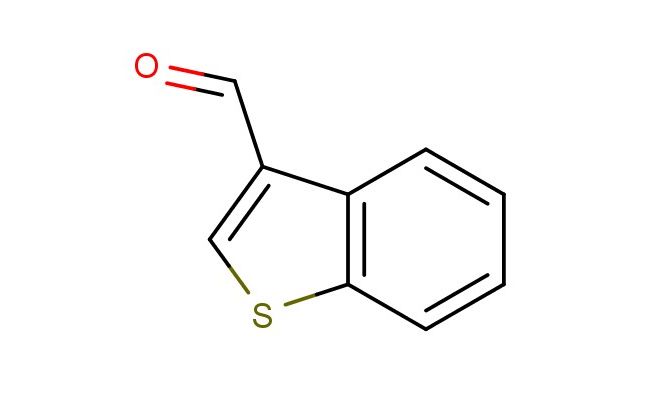
benzo[b]thiophene-3-carbaldehyde
$200.00
CAS No.: 5381-20-4
Catalog No.: 196158
Purity: 95%
MF: C9H6OS
MW: 162.213
Storage: 2-8 degree Celsius
SMILES: S1C2=C(C(=C1)C=O)C=CC=C2
Catalog No.: 196158
Purity: 95%
MF: C9H6OS
MW: 162.213
Storage: 2-8 degree Celsius
SMILES: S1C2=C(C(=C1)C=O)C=CC=C2
For R&D use only. Not for human or veterinary use.
![benzo[b]thiophen-3-amine hydrochloride](https://www.chemshuttle.com/media/catalog/product/cache/eda3e020a548044183bce7a8a96486f8/1/9/196156.jpg)
benzo[b]thiophene-3-carbaldehyde; CAS No.: 5381-20-4; benzo[b]thiophene-3-carbaldehyde. PROPERTIES: This compound presents a benzo[b]thiophene-3-carbaldehyde structure, featuring a benzene ring fused to a thiophene ring with an aldehyde group at position 3. It typically appears as a colorless to pale yellow liquid with a molecular weight of approximately 178.2 g/mol (C10H7OS). Its density is around 1.26 g/cm?, and it has a boiling point of approximately 272-277 C at 760 mmHg. The compound exhibits moderate solubility in organic solvents such as dichloromethane, ethyl acetate, and tetrahydrofuran but is sparingly soluble in water. Proper storage requires a tightly sealed container in a cool, dark environment, preferably under nitrogen to prevent oxidation. Safety considerations include using appropriate PPE and working in a well-ventilated area. It is classified as an irritant (GHS07) with the hazard statement H315-H319. APPLICATIONS: Benzo[b]thiophene-3-carbaldehyde serves as a valuable intermediate in chemical synthesis. Its benzo[b]thiophene-3-carbaldehyde structure enables diverse reactivity patterns, including nucleophilic addition at the aldehyde carbonyl and electrophilic substitution at the thiophene ring. In pharmaceutical development, it is used to construct bioactive molecules, particularly in projects targeting cancer and metabolic disorders. The aldehyde group can be readily modified through condensation reactions to form Schiff bases or through cyanosilylation to introduce nitrile functionalities. This compound also functions as a key building block in the synthesis of liquid crystals and organic semiconductors, where the thiophene moiety contributes to -conjugation. Academic research employs it as a starting material for synthesizing complex architectures in Organic Chemistry and Materials Science journals, focusing on the development of novel functional materials based on thiophene derivatives.
Reviews
Write Your Own Review