



![methyl 2-aminobenzo[d]thiazole-4-carboxylate](https://www.chemshuttle.com/media/catalog/product/cache/31dbf0bffbfa69a5826a72cec9a446de/1/9/194267_2.jpg)

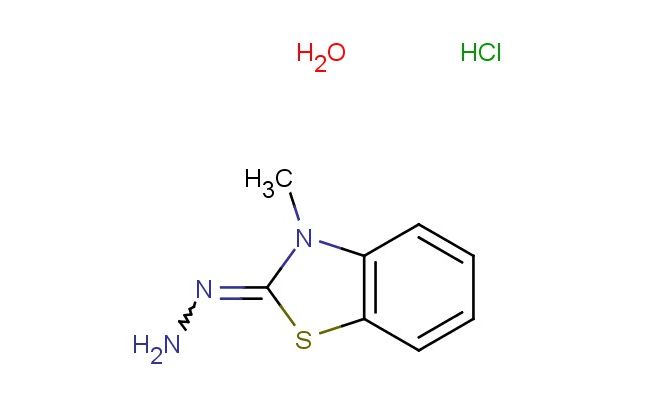
3-methyl-2-benzothiazolinoneHydrazone Hydrochloride Hydrate
$300.00
CAS No.: 149022-15-1
Catalog No.: 195001
Purity: 95%
MF: C8H12ClN3OS
MW: 233.724
Storage: 2-8 degree Celsius
SMILES: O.Cl.CN1C(SC2=C1C=CC=C2)=NN
Catalog No.: 195001
Purity: 95%
MF: C8H12ClN3OS
MW: 233.724
Storage: 2-8 degree Celsius
SMILES: O.Cl.CN1C(SC2=C1C=CC=C2)=NN
For R&D use only. Not for human or veterinary use.

![7,7-dimethyl-4,5,6,7-tetrahydro-2H-pyrazolo[4,3-c]pyridine dihydrochloride](https://www.chemshuttle.com/media/catalog/product/cache/eda3e020a548044183bce7a8a96486f8/1/7/177490_1.jpg)
3-methyl-2-benzothiazolinoneHydrazone Hydrochloride Hydrate; CAS No.: 149022-15-1;3-methyl-2-benzothiazolinone Hydrazine Hydrochloride Hydrate. PROPERTIES: 3-methyl-2-benzothiazolinone Hydrazine Hydrochloride Hydrate is a crystalline solid typically white to off-white in appearance with a molecular weight of approximately 279.8 g/mol. Its exact melting point range is between 210-215 C, and it exhibits good solubility in common polar solvents such as water and methanol. The compound is hygroscopic and sensitive to light, requiring storage in tightly sealed containers away from moisture and direct sunlight. Stability is maintained under ambient temperatures between 15-25 C. From a safety perspective, 3-methyl-2-benzothiazolinone Hydrazine Hydrochloride Hydrate presents moderate toxicity risks. Inhalation precautions are necessary as fine particles can irritate mucous membranes. Skin contact should be minimized due to potential absorption through integumentary systems. Eye protection is crucial as accidental splashes may cause corneal damage. Ingestion constitutes a serious hazard requiring immediate medical attention. Proper handling necessitates use in well-ventilated areas with personal protective equipment including N95 masks, nitrile gloves, and safety goggles. Emergency eyewash stations and safety showers should be readily accessible in laboratory settings where this compound is utilized. Disposal must follow local regulations for hazardous chemical waste. APPLICATIONS: 3-methyl-2-benzothiazolinone Hydrazine Hydrochloride Hydrate serves as a versatile intermediate in pharmaceutical synthesis. Its hydrazine functionality facilitates condensation reactions with carbonyl compounds to form hydrazones, which are valuable intermediates in the preparation of antitubercular agents as described in medicinal chemistry literature (Journal of Medicinal Chemistry). Additionally, this compound functions as a colorimetric reagent for metal ion determination in analytical chemistry applications. When complexed with transition metals, it forms highly colored species detectable via UV-Vis spectroscopy, a method detailed in analytical chemistry protocols (Analytical Chemistry journal). The benzothiazoline core also confers utility as a building block for fluorescent probes used in bioimaging studies. Its ability to undergo cyclization reactions makes it suitable for synthesizing various heterocyclic systems with biological activity.Furthermore, 3-methyl-2-benzothiazolinone Hydrazine Hydrochloride Hydrate has found application in the development of enzyme inhibitors, particularly for carbonic anhydrase, as reported in biochemical research publications. These applications highlight its significance across multiple scientific disciplines beyond its role as a simple chemical intermediate.
Reviews
Write Your Own Review