



![ethyl 6-bromo-1-((2-(trimethylsilyl)ethoxy)methyl)-1H-benzo[d]imidazole-4-carboxylate](https://www.chemshuttle.com/media/catalog/product/cache/31dbf0bffbfa69a5826a72cec9a446de/t/q/tqr0394_1.jpg)
![methyl 2-(2-(4-aminophenyl)-1H-benzo[d]imidazol-6-yl)acetate](https://www.chemshuttle.com/media/catalog/product/cache/31dbf0bffbfa69a5826a72cec9a446de/t/q/tqr0400_1.jpg)
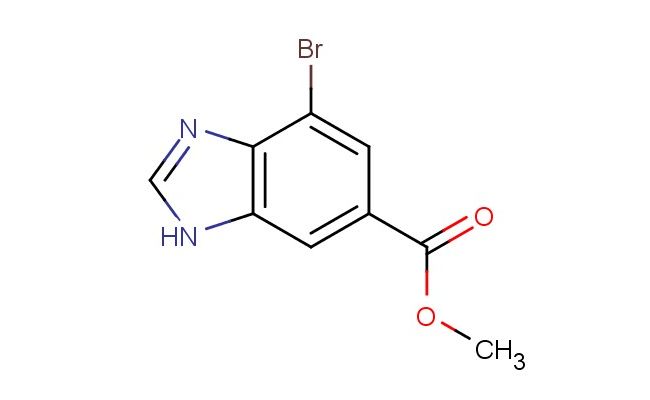
methyl 4-bromo-1H-benzo[d]imidazole-6-carboxylate
$300.00
CAS No.: 1354756-19-6
Catalog No.: TQR0399
Purity: 95%
MF: C9H7BrN2O2
MW: 255.071
Storage: 2-8 degree Celsius
SMILES: BrC1=CC(=CC=2NC=NC21)C(=O)OC
Catalog No.: TQR0399
Purity: 95%
MF: C9H7BrN2O2
MW: 255.071
Storage: 2-8 degree Celsius
SMILES: BrC1=CC(=CC=2NC=NC21)C(=O)OC
For R&D use only. Not for human or veterinary use.




![9-bromo-7-methyl-2-morpholino-4H-pyrido[1,2-a]pyrimidin-4-one](https://www.chemshuttle.com/media/catalog/product/cache/eda3e020a548044183bce7a8a96486f8/1/8/186621_3.jpg)
![9-bromo-2-hydroxy-7-methyl-4H-pyrido[1,2-a]pyrimidin-4-one](https://www.chemshuttle.com/media/catalog/product/cache/eda3e020a548044183bce7a8a96486f8/1/8/185726_3.jpg)


![(R)-7-bromo-2-(difluoromethyl)-1-(1-hydroxypropan-2-yl)-1H-benzo[d]imidazole-5-carboxylic acid](https://www.chemshuttle.com/media/catalog/product/cache/eda3e020a548044183bce7a8a96486f8/y/q/yqf2875.jpg)

CAS NO.: 1354756-19-6; methyl 4-bromo-1H-benzo[d]imidazole-6-carboxylate. PROPERTIES: methyl 4-bromo-1H-benzo[d]imidazole-6-carboxylate presents as pale yellow crystalline solids with a characteristic ester aroma. Its molecular formula is C10H7BrN2O2, corresponding to a molecular weight of 279.07 g/mol. The compound has a melting point between 128-132 C and is moderately soluble in hot ethanol and methylene chloride. Proper storage requires maintenance at 2-8 degree Celsius in glass containers with Teflon-lined caps to prevent degradation. When handling, avoid inhalation of dust particles which may cause respiratory irritation. The substance is stable under dry conditions but undergoes hydrolysis in basic environments, releasing the corresponding carboxylic acid. It is classified as a mild irritant and should be managed in well-ventilated areas. APPLICATIONS: methyl 4-bromo-1H-benzo[d]imidazole-6-carboxylate functions as a versatile building block in heterocyclic chemistry. The brominated position allows for cross-coupling reactions, enabling the synthesis of substituted imidazo[1,2-a]pyridine derivatives with diverse substituents. In pharmaceutical research, this compound serves as a lead structure for developing antiviral agents where the bromine substituent enhances binding affinity to viral proteases. The ester group provides a handle for further functionalization, allowing for the introduction of pharmacophores that improve oral bioavailability. In materials science, derivatives of this compound are used to create nonlinear optical materials where the imidazole ring system contributes to charge transfer properties. Researchers in medicinal chemistry employ this compound to synthesize multitarget-directed ligands that simultaneously modulate several enzymes involved in neurodegenerative diseases. The benzo[d]imidazole core provides a platform for developing fluorescent probes used in bioimaging applications, where specific receptor binding can be visualized in cellular environments.
Reviews
Write Your Own Review