


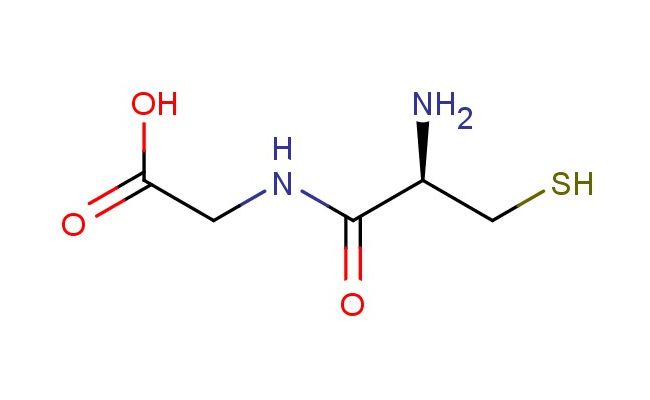


(R)-2-(2-amino-3-mercaptopropanamido)acetic acid
$400.00
CAS No.: 19246-18-5
Catalog No.: 195362
Purity: 95%
MF: C5H10N2O3S
MW: 178.213
Storage: 2-8 degree Celsius
SMILES: N[C@H](C(=O)NCC(=O)O)CS
Catalog No.: 195362
Purity: 95%
MF: C5H10N2O3S
MW: 178.213
Storage: 2-8 degree Celsius
SMILES: N[C@H](C(=O)NCC(=O)O)CS
For R&D use only. Not for human or veterinary use.
(R)-2-(2-amino-3-mercaptopropanamido)acetic acid; CAS No.: 19246-18-5; (R)-2-(2-amino-3-mercaptopropanamido)acetic acid. PROPERTIES: (R)-2-(2-amino-3-mercaptopropanamido)acetic acid appears as a white to off-white crystalline powder with a slight odor. Its molecular formula is C5H11N2O3S, corresponding to a molecular weight of approximately 177.22 g/mol. The compound exhibits a melting point in the range of 150-153 C and demonstrates moderate solubility in water and polar organic solvents such as methanol and dimethylformamide. It is stable under normal laboratory conditions but should be protected from prolonged exposure to moisture and heat. Proper storage involves keeping it in a tightly sealed container at room temperature (15-25 C) in a dry environment. Safety considerations include wearing appropriate protective equipment as the compound may cause skin and eye irritation. Inhalation of dust should be avoided, and in case of accidental exposure, thorough washing with water and medical consultation is advised. APPLICATIONS: (R)-2-(2-amino-3-mercaptopropanamido)acetic acid serves as a valuable intermediate in the synthesis of pharmaceuticals, particularly in the preparation of certain antioxidants and enzyme inhibitors. Its amino and thiol groups provide structural features important for forming stable conjugates with biological targets. In biochemical research, it functions as a building block for creating bioactive peptides and protein analogs. Additionally, it finds application in the development of fluorescent probes for bioimaging, where its thiol group allows for selective labeling of biological targets such as proteins and lipids. The compound is also employed in the synthesis of agrochemicals, though specific applications in this area are limited to non-agricultural research settings.
Reviews
Write Your Own Review