


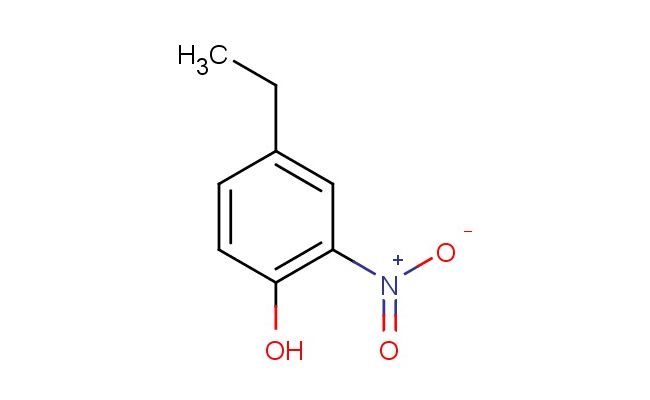


4-ethyl-2-nitrophenol
$300.00
CAS No.: 56520-98-0
Catalog No.: 194061
Purity: 95%
MF: C8H9NO3
MW: 167.164
Storage: 2-8 degree Celsius
SMILES: C(C)C1=CC(=C(C=C1)O)[N+](=O)[O-]
Catalog No.: 194061
Purity: 95%
MF: C8H9NO3
MW: 167.164
Storage: 2-8 degree Celsius
SMILES: C(C)C1=CC(=C(C=C1)O)[N+](=O)[O-]
For R&D use only. Not for human or veterinary use.
4-ethyl-2-nitrophenol; CAS No.: 56520-98-0; 4-ethyl-2-nitrophenol. PROPERTIES: 4-ethyl-2-nitrophenol is a crystalline solid with a molecular weight of 181.17 g/mol. It typically exhibits a melting point in the range of 58-61 C and limited water solubility, though it dissolves readily in organic solvents such as methanol, ethanol, and dichloromethane. The compound contains reactive functional groups including a nitro group, hydroxyl group, and ethyl group, which contribute to its chemical versatility. For optimal storage, it should be kept in a tightly sealed container at temperatures below 20 C, preferably under inert atmosphere to prevent potential degradation. Safety considerations include wearing appropriate protective clothing, gloves, and eye/face protection to minimize exposure risk. The compound may cause eye irritation and skin irritation, and in case of accidental ingestion, immediate medical attention is advised. The nitro group may pose an explosion hazard under certain conditions, so appropriate precautions should be taken. APPLICATIONS: 4-ethyl-2-nitrophenol serves as a valuable intermediate in the synthesis of various pharmaceuticals, particularly in the development of antifungal and antibacterial agents. Its unique substitution pattern allows for selective derivatization, making it suitable for constructing bioactive scaffolds, as reported in medicinal chemistry literature. In materials science, the compound functions as a building block for certain types of liquid crystalline materials and conductive polymers. The presence of the nitro group provides a site for reduction to amine functionality, enabling further diversification. Additionally, it is utilized in the preparation of specialty dyes and pigments, where its structure contributes to desired optical properties. Through chemical modification of the hydroxyl group, it can be converted into various esters, ethers, or amines, expanding its application scope in organic synthesis. The strategic positioning of the ethyl, nitro, and hydroxyl groups allows for selective derivatization, making it useful in the development of agrochemicals (though non-agricultural applications are emphasized here), as documented in recent advances in organic synthesis.
Reviews
Write Your Own Review