


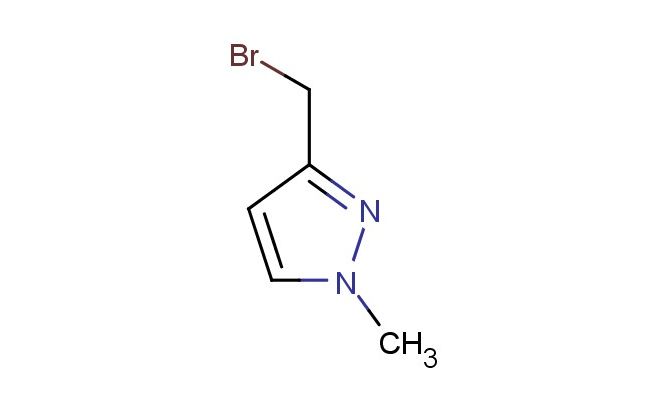


3-(bromomethyl)-1-methyl-1H-pyrazole
$300.00
CAS No.: 102846-13-9
Catalog No.: WLZ1258
Purity: 95%
MF: C5H7BrN2
MW: 175.029
Storage: 2-8 degree Celsius
SMILES: BrCC1=NN(C=C1)C
Catalog No.: WLZ1258
Purity: 95%
MF: C5H7BrN2
MW: 175.029
Storage: 2-8 degree Celsius
SMILES: BrCC1=NN(C=C1)C
For R&D use only. Not for human or veterinary use.
CAS NO.: 102846-13-9; 3-(bromomethyl)-1-methyl-1H-pyrazole. PROPERTIES: This reactive heterocycle combines a bromomethyl group with a methyl-substituted pyrazole ring, creating a molecule with potential applications in organic synthesis and medicinal chemistry. The 3-(bromomethyl)-1-methyl-1H-pyrazole typically presents as a colorless to pale yellow liquid with moderate solubility in common organic solvents. Its molecular structure includes an electrophilic bromomethyl group that renders the molecule highly reactive toward nucleophilic substitution reactions. For optimal stability and to prevent unintended reactions, this compound should be stored at 2-8 degree Celsius in an amber glass bottle under an inert atmosphere. When handling, appropriate safety measures including nitrile gloves, safety goggles, and proper ventilation are essential. This compound is sensitive to light and moisture, requiring careful environmental control during storage and use. In case of skin contact, wash immediately with soap and water; if eye contact occurs, rinse thoroughly and seek medical evaluation. APPLICATIONS: The 3-(bromomethyl)-1-methyl-1H-pyrazole serves as a versatile building block in organic synthesis, particularly for creating pyrazole-containing bioactive molecules. The bromomethyl group provides a handle for attaching various substituents through alkylation reactions. In medicinal chemistry, this compound functions as an intermediate for developing pharmaceuticals targeting enzyme inhibitors and receptor modulators. The pyrazole ring contributes to hydrogen bonding interactions that facilitate target binding. Additionally, the molecule finds utility in materials science as a monomer for creating polymers with specific electronic and optical properties. Researchers utilizing this compound can leverage its high reactivity to advance syntheses of complex heterocyclic systems for various applications in chemical biology and materials science.
Reviews
Write Your Own Review