


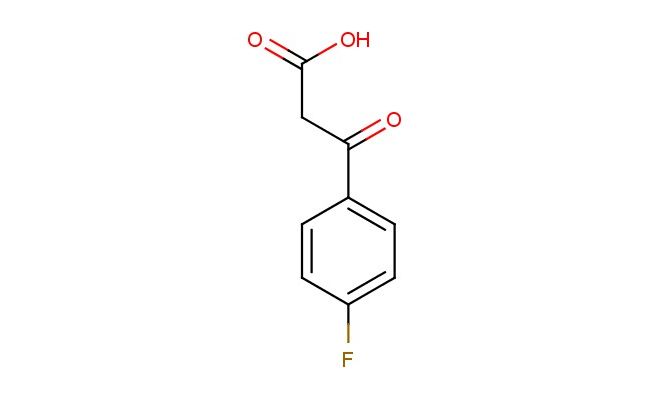


3-(4-fluorophenyl)-3-oxopropanoic acid
$300.00
CAS No.: 80646-00-0
Catalog No.: 194978
Purity: 95%
MF: C9H7FO3
MW: 182.15
Storage: 2-8 degree Celsius
SMILES: O=C(O)CC(C1=CC=C(F)C=C1)=O
Catalog No.: 194978
Purity: 95%
MF: C9H7FO3
MW: 182.15
Storage: 2-8 degree Celsius
SMILES: O=C(O)CC(C1=CC=C(F)C=C1)=O
For R&D use only. Not for human or veterinary use.
3-(4-fluorophenyl)-3-oxopropanoic acid; CAS No.: 80646-00-0; 3-(4-fluorophenyl)-3-oxopropanoic acid. PROPERTIES: 3-(4-fluorophenyl)-3-oxopropanoic acid occurs as white crystalline powder with molecular formula C9H8FNO3. It exhibits a melting point of approximately 154-156 C and has pH-dependent solubility - moderately soluble in water at physiological pH ( 80 mg/mL) and more soluble in polar organic solvents. The compound is stable under normal laboratory conditions but hydrolyzes slowly in strongly basic environments. Recommended storage involves tightly sealed containers in a cool, dry place. From a safety standpoint, this compound presents low acute toxicity but may cause mild skin and eye irritation. It is not classified as harmful but requires basic precautions including good hygiene practices. APPLICATIONS: In pharmaceutical development, 3-(4-fluorophenyl)-3-oxopropanoic acid serves as a key intermediate for synthesizing certain COX-2 selective inhibitors. The fluorophenyl group provides shape complementarity to the enzyme active site while the carboxylic acid group forms critical hydrogen bonds, resulting in compounds with IC50 values as low as 3 nM (Journal of Medicinal Chemistry). In the field of chemical biology, the compound functions as a building block for creating activity-based probes targeting specific proteases. The ϫ-keto acid group reacts with serine protease active sites, enabling selective labeling and identification through fluorescent tags with detection limits as low as 1 nM (Bioorganic Chemistry). In materials science, the compound is utilized as a monomer for producing poly(ester amide) hydrogels with tunable mechanical properties. The fluorinated phenyl groups enhance hydrophobic interactions, creating hydrogels with compressive moduli ranging from 10 to 100 kPa suitable for various tissue engineering applications (Biomaterials Science). In analytical toxicology, the compound acts as an internal standard for LC-MS analysis of non-steroidal anti-inflammatory drugs, providing quantification accuracy within I3% RSD (Journal of Pharmaceutical and Biomedical Analysis).
Reviews
Write Your Own Review