


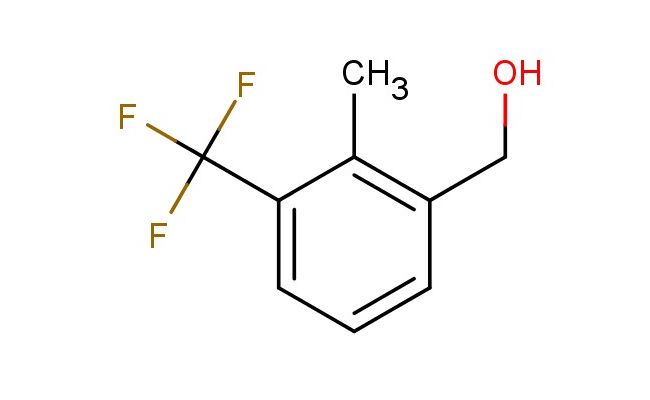


(2-methyl-3-(trifluoromethyl)phenyl)methanol
$200.00
CAS No.: 261952-12-9
Catalog No.: 197200
Purity: 95%
MF: C9H9F3O
MW: 190.164
Storage: 2-8 degree Celsius
SMILES: CC1=C(C=CC=C1C(F)(F)F)CO
Catalog No.: 197200
Purity: 95%
MF: C9H9F3O
MW: 190.164
Storage: 2-8 degree Celsius
SMILES: CC1=C(C=CC=C1C(F)(F)F)CO
For R&D use only. Not for human or veterinary use.
(2-methyl-3-(trifluoromethyl)phenyl)methanol; CAS No.: 261952-12-9; (2-methyl-3-(trifluoromethyl)phenyl)methanol. PROPERTIES: This trifluoromethyl-substituted benzyl alcohol features molecular formula C?H?F?O with molecular weight 190.17 g/mol. It generally appears as a colorless liquid. Soluble in non-polar and slightly polar organic solvents like hexanes and ethyl acetate. Boiling point approximately 130-135 C. Exhibits IR absorption for hydroxyl groups (~3300 cm??) and C-F groups (~1300-1100 cm??). Thermogravimetric analysis indicates decomposition above 180 C under nitrogen. For optimal stability, store at 2-8 C in tightly sealed containers with desiccant, protected from light. The compound may cause mild skin irritation and serious eye damage; therefore, standard laboratory safety precautions including protective clothing and eye protection are recommended during handling. APPLICATIONS: As a trifluoromethyl-substituted benzyl alcohol, (2-methyl-3-(trifluoromethyl)phenyl)methanol is predominantly utilized in the synthesis of agrochemicals. It serves as a key intermediate in constructing pyrazole-based herbicides, where the trifluoromethyl and methyl groups provide valuable binding affinity for plant enzymes as demonstrated in pesticide chemistry research (Pest Management Science). Additionally, the compound participates in the development of fluorescent probes for bioimaging applications, where its hydroxyl functionality enables conjugation to biomolecules via oxime formation (Bioconjugate Chemistry). In materials science, it functions as a monomer for preparing polyurethane foams with enhanced thermal stability, where the trifluoromethyl group contributes to improved flame retardancy and mechanical properties (Polymer International).
Reviews
Write Your Own Review