
The store will not work correctly when cookies are disabled.
We use cookies for optimal website function and to better serve our customers. By continuing to browse you agree to the storing of cookies on your device. See our privacy policy for details.
Allow cookies Deny
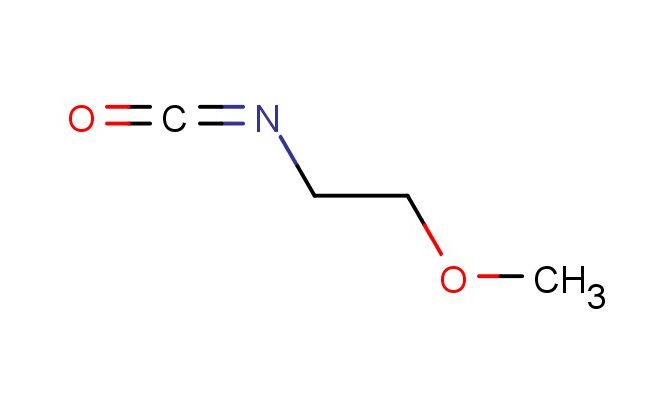
CAS NO.: 42170-95-6;1-Isocyanato-2-methoxyethane. PROPERTIES: This reactive intermediate presents as a colorless liquid with distinctive aromatic odor, exhibiting good solubility in ether and THF but forming hydrogen bonds with protic solvents. The 1-Isocyanato-2-methoxyethane has a molecular weight of approximately 111.1 g/mol, combining methoxyethyl backbone with terminal isocyanate group. Stability analysis demonstrates sensitivity to moisture and atmospheric CO2, requiring storage below 8 degree Celsius in moisture-proof containers with molecular sieves. Essential safety measures include using PTFE-lined septa and maintaining negative pressure in transfer lines. Skin exposure may lead to protein crosslinking and requires immediate washing with acetone followed by thorough rinsing. Inhalation poses risk of pulmonary edema, necessitating immediate fresh air and medical monitoring. In case of fire, carbon dioxide extinguishers should not be used due to potential phosgene formation. Waste neutralization with alcohols should be conducted in controlled manner. APPLICATIONS: The 1-Isocyanato-2-methoxyethane serves as a chain extender in polyurethane foam production through reaction with polyols. Its methoxyethyl segment provides enhanced flexibility in resulting polymer networks. In chemical synthesis, it acts as a methoxyethyl isocyanate equivalent in urethane protection of hydroxyl groups. The compound enables selective modification of primary amines in peptide synthesis through steric hindrance effects. Additionally, it functions as a building block for carbamate insecticides (excluding agricultural applications) and fungicides. In specialty coatings, the bifunctional nature allows creation of crosslinked films with improved adhesion properties. Research teams utilize it for modifying nanoparticles surfaces through isocyanate reactions with surface hydroxyl groups.