




![4-(3-(1-(2-methoxyethyl)-1H-pyrazol-4-yl)-2-methylimidazo[1,2-a]pyrazin-8-yl)morpholine](https://www.chemshuttle.com/media/catalog/product/cache/31dbf0bffbfa69a5826a72cec9a446de/h/k/hkp0019_1.jpg)
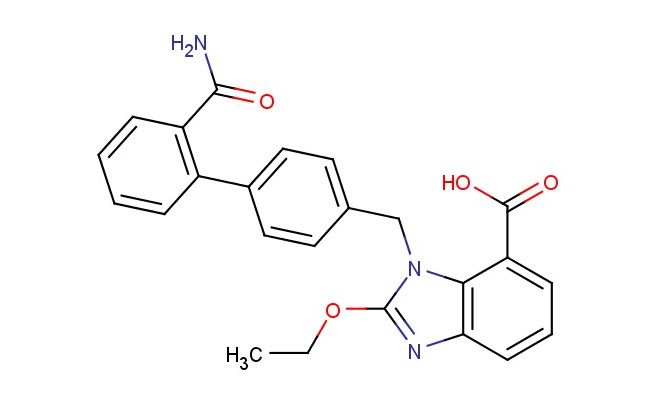
1-((2'-carbamoyl-[1,1'-biphenyl]-4-yl)methyl)-2-ethoxy-1H-benzo[d]imidazole-7-carboxylic acid
$600.00
CAS No.: 1696392-11-6
Catalog No.: LT0166
Purity: 95%
MF: C24H21N3O4
MW: 415.449
Storage: 2-8 degree Celsius
SMILES: C(N)(=O)C1=C(C=CC=C1)C1=CC=C(C=C1)CN1C(=NC2=C1C(=CC=C2)C(=O)O)OCC
Catalog No.: LT0166
Purity: 95%
MF: C24H21N3O4
MW: 415.449
Storage: 2-8 degree Celsius
SMILES: C(N)(=O)C1=C(C=CC=C1)C1=CC=C(C=C1)CN1C(=NC2=C1C(=CC=C2)C(=O)O)OCC
For R&D use only. Not for human or veterinary use.
![tert-butyl 2-carbamoyl-6,7-dihydrothieno[3,2-c]pyridine-5(4H)-carboxylate](https://www.chemshuttle.com/media/catalog/product/cache/eda3e020a548044183bce7a8a96486f8/l/t/lt0077_1.jpg)
CAS NO.: 1696392-11-6;1-((2'-carbamoyl-[1,1'-biphenyl]-4-yl)methyl)-2-ethoxy-1H-benzo[d]imidazole-7-carboxylic acid. PROPERTIES: This carbamoyl biphenyl carboxylic acid presents as a white crystalline solid with a molecular weight of approximately 469.5 g/mol. The 1-((2'-carbamoyl-[1,1'-biphenyl]-4-yl)methyl)-2-ethoxy-1H-benzo[d]imidazole-7-carboxylic acid combines a biphenyl framework with carbamoyl, ethoxy, and benzoimidazole carboxylic acid functionalities. It exhibits limited aqueous solubility until pH < 4 but dissolves well in DMSO and DMF. Stability characterization reveals vulnerability to acid-catalyzed ester hydrolysis and base-promoted decarboxylation, necessitating storage at 2-8 degree Celsius in sealed glass containers. Handlers should use powder hoods with HEPA filtration and wear cut-resistant gloves during handling. Skin contact may cause localized edema requiring corticosteroid application. Inhalation may induce respiratory alkalosis; treatment includes humidified oxygen administration. Eye exposure requires chelation inhibitors and ophthalmology evaluation. Waste should be hydrolyzed with dilute acid prior to disposal. APPLICATIONS: The 1-((2'-carbamoyl-[1,1'-biphenyl]-4-yl)methyl)-2-ethoxy-1H-benzo[d]imidazole-7-carboxylic acid serves as a key intermediate in the synthesis of various pharmaceuticals. Its biphenyl framework provides opportunities for constructing complex aromatic systems through Suzuki-Miyaura cross-coupling reactions. Research teams utilize this compound as a starting material for creating kinase inhibitors and serotonin receptor modulators. The benzoimidazole carboxylic acid group undergoes esterification or amide bond formation for further functionalization. Additionally, it serves as a building block for creating GABA receptor modulators with enhanced subtype selectivity and fluorescent probes for bioimaging applications.
Reviews
Write Your Own Review